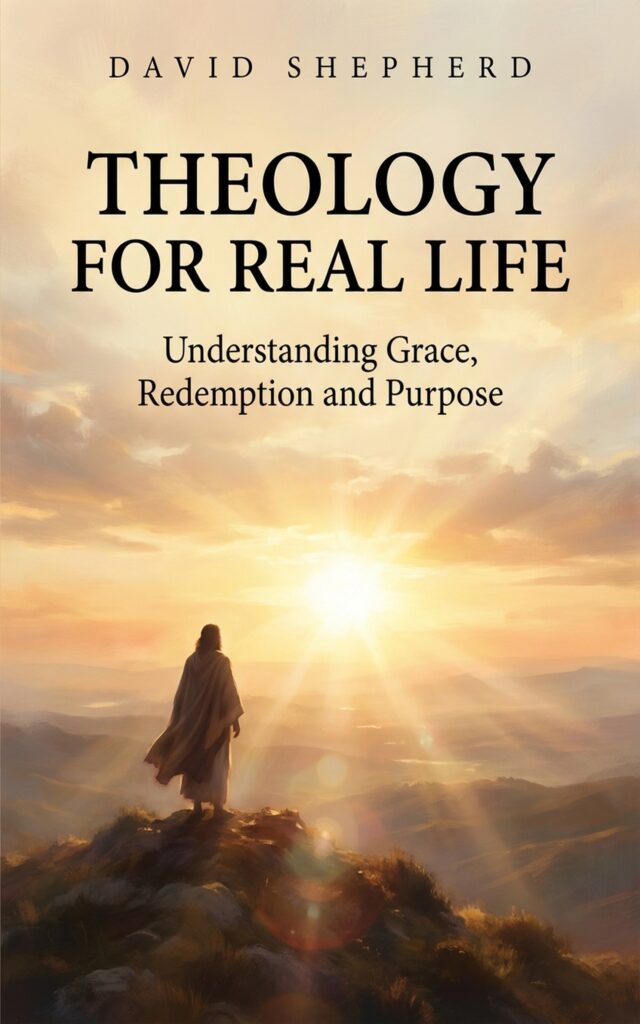
Be the first to review “Theology for Real Life: Understanding Grace, Redemption and Purpose” Cancel reply
Faith is not separate from real life. It shapes how we work, love, parent, rest, and face uncertainty. This book brings biblical wisdom into everyday situations and offers practical guidance for living with purpose and grace in a complicated world.
The material is written for Christians who want more than inspiration. It combines Scripture, reflection, and actionable insight to help you grow in faith where it actually matters: your relationships, your work, your mind, and your habits. The tone is honest and grounded, acknowledging that following Jesus is both joyful and challenging.
Each section is designed to move you from understanding to practice. You will find biblical foundations, real-life application, and encouragement to take the next step. Whether you are reading on your own, with a small group, or as part of a devotional rhythm, this book meets you where you are.
If you are looking for a resource that respects your intelligence, speaks to your real struggles, and points you back to Christ, this book is a worthwhile companion. It does not promise easy answers, but it does offer truth that holds up under pressure.
Not sure yet? Here is the full table of contents and the first chapter, exactly as it appears in the book.
25 chapters in the complete book.
Let me tell you about Sarah. She’s a thirty-two-year-old marketing professional living in Seattle, juggling a demanding career, a young family, and the constant pressure to keep up with everything life throws at her. Sarah grew up attending church occasionally, but somewhere along the way, theology became something she associated with dusty libraries, complicated arguments about ancient texts, and old men in robes debating questions that seemed utterly disconnected from her Monday morning commute or her Friday evening exhaustion. When I asked her recently whether theology mattered to her daily life, she laughed. “I’m just trying to get through the day without losing my mind. I don’t have time for abstract religious philosophy.”
Yet here’s what struck me about our conversation: within twenty minutes, Sarah had raised profound theological questions without even realizing it. She wondered whether her life had genuine meaning beyond her job title and income bracket. She struggled with guilt over not being a perfect mother while simultaneously resenting the impossible standards placed on women. She questioned whether forgiveness was even possible after her brother’s betrayal two years ago. She asked whether there was any basis for hope in a world that seemed increasingly chaotic and divided. Every single one of these concerns (these midnight anxieties and coffee-break questions) sits squarely in the domain of theology.
The disconnect between Sarah’s perception and her actual wrestling with deeply theological questions represents one of the great tragedies of our contemporary moment. We have allowed theology to be relegated to the academy, to become the private domain of specialists and scholars, when it is actually the most practical framework for making sense of the complexities of human existence. Theology is not an escape from real life. It is the interpretive lens that makes sense of real life.
The word theology itself comes from two Greek words: theos meaning God, and logos meaning word, reason, or study. At its core, theology is simply thinking carefully about God and the implications of God’s existence and character for everything else. But this simple definition contains explosive power. If God exists and if God’s nature can be known, then every aspect of reality must be understood in relationship to that central truth. Theology becomes the master key that unlocks the meaning of our identity, our relationships, our suffering, our purpose, and our destiny.
Consider how you make decisions every single day. This morning, you likely made dozens of choices, from trivial ones about what to eat for breakfast to potentially significant ones about how to respond to a difficult email or whether to speak up in a meeting. Each decision, whether you recognize it or not, reflects an underlying worldview shaped by theological assumptions. When you choose honesty over deception, you’re operating from beliefs about truth and human dignity. When you extend patience to your children or compassion to a struggling friend, you’re acting from convictions about human worth and moral obligation. Guilt, hope, purpose, despair, you’re encountering theological realities whether you use theological language to describe them or not.
The question is never whether theology shapes your life. The question is whether you will engage theology consciously and critically, or whether you will live with an unexamined jumble of half-formed beliefs absorbed unconsciously from culture, family, media, and random experiences. As the philosopher Mortimer Adler observed, philosophy and theology are inescapable. Everyone operates from foundational assumptions about reality, whether they examine those assumptions carefully or not. The only question is whether those assumptions are coherent, consistent with reality, and actually workable in the crucible of daily life.
This brings us to a key insight: bad theology doesn’t disappear when people stop consciously thinking about it. Instead, it goes underground, where it operates with even more power precisely because it remains unexamined. I have watched people build entire lives on theological premises they would reject if stated clearly and directly. I have seen individuals torture themselves with false guilt rooted in distorted conceptions of God’s character. I have witnessed families fractured by competing but unarticulated visions of human purpose and identity. Communities torn apart by tribal loyalties masquerading as principled conviction. In each case, the problem was not too much theology but too little: not enough clear thinking about ultimate realities and their practical implications.
The modern secular narrative would have us believe that we can simply bracket questions about God, purpose, and ultimate meaning, focusing instead on pragmatic concerns like career success, personal happiness, and social harmony. But this project has failed spectacularly. Far from creating a more peaceful and rational society, the attempt to function without coherent theological foundations has left millions of people adrift in a sea of relativism, anxiety, and existential confusion. When the Pew Research Center conducts surveys on meaning and purpose in life, the responses reveal a culture desperately seeking something solid to stand on, some framework that makes sense of both the beauty and brutality of human experience.
The rise of mental health crises, particularly among young people, cannot be separated from the collapse of coherent meaning-making frameworks. When psychologists like Viktor Frankl documented the relationship between meaning and human flourishing, they were touching on fundamentally theological territory. Frankl, a Holocaust survivor, observed that those who maintained a sense of purpose were far more likely to survive the concentration camps than those who lost it, regardless of physical strength or health. His entire therapeutic approach, logotherapy, built on the insight that humans are meaning-seeking creatures who cannot thrive without a coherent narrative that explains who they are, why they exist, and what their suffering might mean.
This is where the three theological concepts at the heart of this book become essential: grace, redemption, and purpose. These are not abstract doctrines for seminary students to debate. They are the load-bearing pillars that support a livable, coherent, and hope-filled approach to human existence. Let me sketch briefly how each addresses fundamental human needs before we explore them in much greater detail throughout this book.
Grace speaks directly to the human experience of inadequacy and failure. Every honest person knows the gap between who they are and who they ought to be. We disappoint ourselves, wound others, and fall short of even our own standards, let alone any transcendent standard of goodness. The cultural response oscillates wildly between two extremes. On one hand, we lower standards to the point of meaninglessness, declaring that everyone’s choices are equally valid and nothing is wrong. On the other hand, we create performance treadmills where worth must be earned through achievement, productivity, or moral superiority. Both approaches leave people exhausted and hollow.
Grace offers a radically different foundation. It declares that human worth is not earned through performance but bestowed as a gift by a God who loves extravagantly and forgives fully. This is not cheap grace that dismisses wrongdoing or removes accountability. Rather, it is costly grace that acknowledges the seriousness of human moral failure while simultaneously declaring that failure need not be the final word. For Sarah, the marketing professional struggling with guilt and impossible standards, this means she can acknowledge her limitations without descending into self-hatred. Her worth as a mother, professional, and human being does not depend on flawless performance but rests on something more stable and unshakeable.
Redemption addresses the haunting question of whether our brokenness defines us permanently or whether genuine transformation is possible. We live in a culture simultaneously obsessed with personal growth and deeply cynical about whether people can really change. We consume self-help content voraciously while harboring profound doubts about whether lasting change is anything more than wishful thinking. We speak the language of second chances while keeping meticulous records of others’ failures and our own.
The theological concept of redemption proclaims that restoration is not only possible but central to the nature of reality itself. God is fundamentally a redeeming God who specializes in bringing beauty from ashes, purpose from pain, and renewal from ruin. This is not naive optimism that pretends brokenness doesn’t exist. It is hope rooted in the character of a God who has demonstrated throughout history a pattern of redeeming what seems irredeemable. For Sarah’s brother, whose betrayal created a seemingly unbridgeable chasm in their relationship, redemption opens the possibility that reconciliation might be more than a fantasy. It provides a framework for genuine repentance, authentic forgiveness, and the slow, difficult work of rebuilding trust.
Purpose confronts the existential vacuum that characterizes so much of modern life. We are more connected than ever through technology yet more isolated and lonely. We have more opportunities for self-expression yet feel increasingly invisible and insignificant. We pursue happiness with single-minded determination yet find it maddeningly elusive. The problem, at root, is that we have lost any sense of overarching purpose that transcends individual preference and subjective experience.
Theology insists that human beings are not cosmic accidents but intentional creations of a purposeful God. Our lives have meaning because they fit within a larger story, a grand narrative of creation, fall, redemption, and restoration. This is not purpose we manufacture for ourselves but purpose we discover through relationship with the God who designed us. For Sarah, this means her life matters not because of her professional accomplishments or social media following but because she bears the image of God and plays a unique role in God’s unfolding purposes for the world. Her daily choices to love her family, serve her neighbors, and pursue excellence in her work connect to something infinitely larger than her immediate circumstances.
These three concepts work together as an integrated framework. Grace without redemption might comfort us temporarily but leaves us stuck in our brokenness. Redemption without purpose might change us but provides no direction for that transformation. Purpose without grace becomes another performance treadmill that crushes rather than liberates. Together, however, grace, redemption, and purpose form a solid theological foundation capable of supporting human flourishing even in the midst of suffering, complexity, and uncertainty.
The practical implications ripple outward into every dimension of life. In relationships, these theological realities transform how we navigate conflict, extend forgiveness, and build genuine intimacy. In work, they reshape our understanding of vocation, success, and the meaning of our daily labor. In suffering, they provide resources for endurance and hope that neither deny pain nor are crushed by it. In ethical decision-making, they offer principles rooted in the character of God rather than the shifting sands of cultural preference. In our search for identity, they anchor us in truths more solid than our feelings, circumstances, or the opinions of others.
I think of Marcus, a technology entrepreneur who built a successful startup but found himself hollowed out by the very success he had pursued so relentlessly. He came to me asking whether his life had any meaning beyond making money and impressing investors. As we talked, he realized he had been operating from an unexamined theology that equated human worth with economic productivity and social status. When his company faced a serious setback, his entire sense of identity collapsed because it had been built on such an unstable foundation. Engaging theology seriously did not solve all his problems instantly, but it did provide Marcus with a framework for understanding his worth independent of business outcomes and a vision of purpose that could survive failure.
Or consider Jennifer, a college student wrestling with questions about sexual ethics in an environment where any appeal to traditional moral standards was dismissed as oppressive and judgmental. She felt trapped between her intuition that some boundaries were healthy and necessary and the cultural insistence that any restraint reflected repression and fear. Theological engagement gave her a language for understanding human sexuality as a good gift designed for specific contexts, with boundaries that protect rather than restrict human flourishing. She discovered that grace and truth were not opposing values but complementary realities that together made sense of both the beauty and boundaries of human intimate relationships.
Or think about David and Rachel, a couple whose marriage was crumbling under the weight of accumulated hurts, unmet expectations, and the simple exhaustion of trying to make life work. Counseling helped them develop better communication skills, but what ultimately transformed their relationship was engaging the theological reality of covenant love. They began to understand marriage not primarily as a contract for mutual benefit but as a covenant reflecting God’s faithful, patient, self-sacrificing love. This shift did not make their challenges disappear, but it provided a foundation strong enough to support the difficult work of reconciliation and renewal.
These stories illustrate an important point: theology matters today because the questions it addresses are the questions every human being faces eventually. You cannot live a fully human life without grappling with issues of meaning, morality, identity, suffering, purpose, forgiveness, hope, and destiny. These are not optional extras for people interested in religion. They are the unavoidable challenges of conscious existence. The only question is whether you will face them with the resources of a coherent theological framework or try to improvise answers from the cultural scraps available in self-help books, motivational videos, and the comment sections of social media.
This book exists because I believe that historical Christian theology, properly understood and applied, provides the most satisfying and workable framework for human flourishing available anywhere. I am not claiming that Christians always live up to these theological truths or that church history is free from tragic failures and betrayals of the gospel. I am claiming that when we examine the core theological claims of Christianity regarding grace, redemption, and purpose, we find resources adequate to the deepest challenges and highest aspirations of human life.
In the chapters that follow, we will explore these concepts carefully, unpacking their meaning, examining their biblical foundations, and tracing their practical implications. We will address common objections and misunderstandings. We will look at how these truths apply to concrete situations you face in your relationships, work, suffering, and daily decisions. We will consider how theological literacy equips you to evaluate competing worldviews and live well in a pluralistic culture without either arrogant dismissiveness or spineless relativism.
My aim is not to make you into a professional theologian but to help you become a theologically informed person who can think clearly about ultimate realities and live confidently from that clarity. I want you to discover that theology is not the enemy of engaged, fully human life but rather its essential foundation. I want you to experience theology not as a burden but as a liberation, not as restrictive rules but as life-giving truth.
As we begin this journey together, I invite you to bring your questions, doubts, and real-life struggles. Theology done well is not afraid of hard questions or honest doubt. It welcomes them as part of the process of moving from shallow familiarity to deep understanding. You do not need to check your intellect at the door or pretend to believe things you find incredible. You do need to be willing to examine your assumptions, follow arguments where they lead, and consider the possibility that reality might be richer and more wonderful than you have imagined.
The theologian Karl Barth was once asked to summarize his complex, multi-volume theological work in a single sentence. He thought for a moment and then replied with the words of a simple children’s song: “Jesus loves me, this I know, for the Bible tells me so.” The questioner was shocked by such a simplistic response from such a brilliant scholar. But Barth understood something profound: the most sophisticated theology ultimately serves to unpack and apply that simple, staggering claim about divine love. Everything else flows from that fountain.
This is the heart of why theology matters today. Not because we need more information to memorize or more arguments to win debates, but because we need to know deeply and live fully from the reality that we are loved by God, that our failures need not define us, that transformation is possible, and that our lives have meaning and purpose within God’s grand story. These truths change everything. How you see yourself when you look in the mirror. How you relate to others in your most intimate relationships and casual encounters. How you face suffering, make decisions, spend your time, and invest your life.
Sarah, the marketing professional we met at the beginning of this chapter, eventually joined a small group where we worked through theological questions together. She discovered that theology was not abstract and irrelevant but intensely practical and immediately applicable. She found language for questions she had been asking inarticulately for years. She discovered resources for facing her guilt, her relationships, and her search for meaning that proved far more satisfying than either perfectionism or relativism. Her life did not become problem-free, but it did become rooted in something solid enough to bear weight.
This is what I hope for you as well. That you would discover theology not as a dusty academic discipline but as the living water that quenches our deepest thirst for meaning, belonging, and hope. That you would find in the great theological truths of grace, redemption, and purpose the framework for building a life that can weather storms and soar in joy. That you would become someone who thinks clearly about what matters most and lives courageously from that clarity.
The journey begins here, with the simple but revolutionary recognition that theology matters today because the questions it addresses are the questions that matter most. Everything else in this book flows from that foundational insight. So let’s begin exploring together what it means to live in light of grace, redemption, and purpose in the real world of jobs and relationships, suffering and celebration, doubt and faith, failure and hope. The adventure awaits.
… and that is just the beginning. The complete book continues from here, instant download, DRM-free, yours to keep.





Reviews
There are no reviews yet.