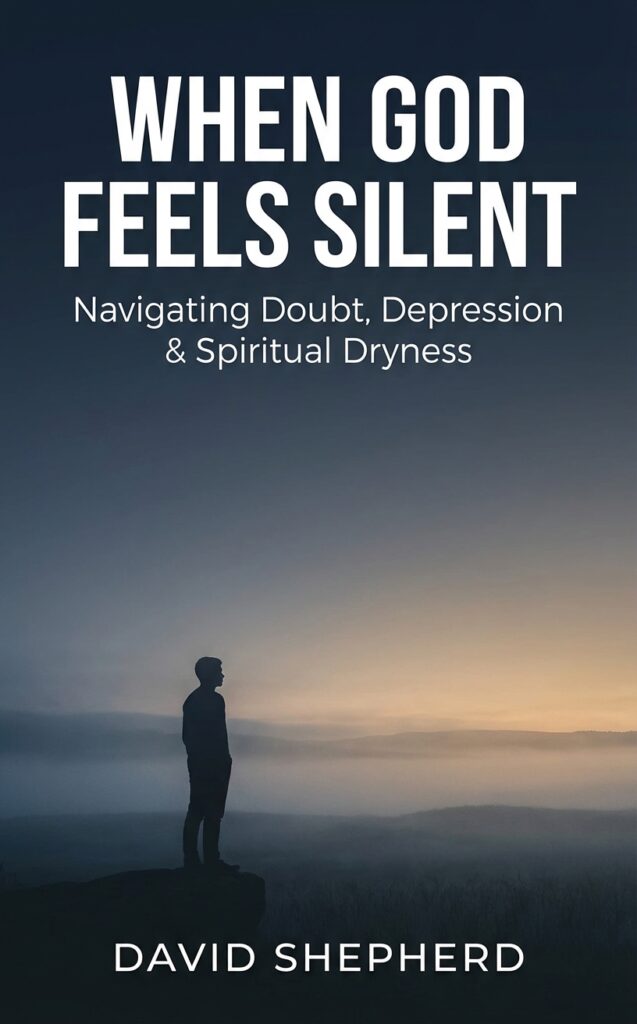
Be the first to review “When God Feels Silent: Navigating Doubt, Depression & Spiritual Dryness” Cancel reply
Have you ever felt abandoned by God? You’re not alone. And silence doesn’t mean absence.
When God Feels Silent is a compassionate, theologically grounded exploration of one of faith’s most disorienting experiences: the sense that God has gone quiet. Author David Shepherd meets you in the raw loneliness of unanswered prayer and the confusion of faith that no longer feels alive, offering both validation and hard-won hope.
This isn’t a book of easy answers. Instead, Shepherd invites you to stop interpreting divine silence as abandonment and to begin understanding it as a recognizable passage that believers across traditions have always navigated. Whether you’re experiencing spiritual dryness, wrestling with doubt, or struggling through clinical depression, this book carefully distinguishes between these experiences while honoring each one with seriousness and care.
What you’ll discover:
• Why the feeling of God’s absence is not evidence of spiritual failure
• How to integrate mental health care with authentic faith
• A vocabulary for experiences you’ve felt but couldn’t name
• Practical and theological frameworks for living faithfully in seasons of silence
• The profound companionship of those who have walked through darkness
Written in a measured, warm tone (the voice of someone who has sat in the dark long enough to know its contours), this guided exploration moves from crisis toward clarity, from confusion toward sober confidence. Perfect for individuals in their own season of silence, pastoral leaders, counselors, spiritual directors, and anyone who feels too honest for easy answers and too hungry for meaning to abandon the search.
For those stranded between belief and despair, here is a companion who understands.
Not sure yet? Here is the full table of contents and the first chapter, exactly as it appears in the book.
20 chapters in the complete book.
There is a particular kind of loneliness that is hard to describe to people who haven’t felt it. It’s not the loneliness of being new in a city, or of losing a friend, or of spending a Friday night alone. It’s the loneliness of sitting in a pew (or on your knees, or in your car outside the church parking lot because you can’t quite face going inside) and feeling with absolute certainty that the God you have built your life around is simply not there.
Not angry with you. Not testing you in some dramatic, movie-worthy way. Just… absent. Gone quiet. The line, as far as you can tell, has gone dead.
If you’ve felt that, this book is for you.
And if you’re currently in that place (if you picked this up because the title hit a nerve you weren’t expecting it to hit) then I want to say something to you before we go any further: you are not alone, you are not broken, and what you are experiencing has a long, legitimate, and even sacred history within the life of faith. It does not mean God has abandoned you. It does not mean your faith was never real. And it does not mean something has gone fundamentally wrong with you.
But I also don’t want to rush past how much it hurts. Because it does. Terribly, sometimes.
The thing nobody told you
Most of us were given a version of faith that came with a fairly clear operating manual. Pray, and God will speak to you. Read the Bible, and it will come alive. Worship, and you will feel his presence. Follow Jesus, and even in the hard times, you’ll have a peace that passes understanding. There was room in that framework for suffering, we were told faith wouldn’t be easy, that there would be trials, that the road would be narrow. But underneath all of that was an unspoken assumption: God would be present through it. His voice might be quiet, but it would be there. His hand might be hidden, but you’d sense it guiding you.
What nobody adequately prepared most of us for was the possibility that there would come a season (maybe a long one) where none of that felt true. Where prayer felt like pressing your face against a locked door. Where the Bible felt like reading someone else’s letters about someone you used to know. Where worship felt performative, hollow, slightly embarrassing. Where the God who had once felt as real and close as your own heartbeat suddenly felt like a concept you were struggling to believe in at all.
And the most disorienting part? You couldn’t always point to a reason. Sometimes there was one, a loss, a trauma, a crisis of conscience, a church wound, an unanswered prayer that finally broke something open. But sometimes there wasn’t. Sometimes the silence crept in quietly, like a fog, and by the time you noticed it, you couldn’t quite remember when it had started or work out how to make it stop.
This is what I’m calling the silence nobody warns you about. Not a rough patch. Not a bad week. Not the ordinary fluctuation of faith that every believer experiences as seasons change. Something deeper and stranger than that. A silence so profound it begins to reshape how you see yourself, how you see the world, and whether you still believe what you thought you believed.
You’re probably carrying this alone
Here’s something I’ve noticed after years of pastoral ministry and honest conversation with fellow believers: almost everyone who goes through a season of spiritual silence carries it alone, or nearly alone. The reason isn’t hard to understand.
The church (and I say this with love, because I am the church and so are you) is not always the safest place to be honest about doubt. There is enormous pressure, often unspoken but deeply felt, to present a faith that is holding together. To have a testimony with a tidy arc. To speak of God in confident, present-tense terms. When someone asks how you’re doing spiritually, the expected answer exists in a narrow range: struggling but growing, going through a hard season but leaning on God, not perfect but pressing in. What falls outside that range (what tends to create an awkward silence of its own) is saying, honestly, I don’t feel God at all right now. I’m not sure he’s listening. I’m going through the motions and I don’t know how much longer I can keep doing it.
So people don’t say it. They smile and sing the songs and raise their hands and keep the experience locked quietly inside, where it festers and grows heavier every week. And because nobody says it, everybody who’s going through it assumes they’re the only one, which makes the isolation even more complete.
If this is you, I want to break that isolation right now. What you are feeling is not rare. It is not exotic. It is not a sign that you are spiritually defective in some unique way. Across traditions, across centuries, across cultures, people who loved God deeply and followed him faithfully have walked through exactly this territory. The desert fathers and mothers of the early church knew it. The great medieval mystics knew it. John of the Cross gave it a name, the dark night of the soul, and wrote about it with a precision and tenderness that still takes your breath away. Teresa of Ávila knew it. Thomas Merton knew it. C.S. Lewis, after his wife Joy died, wrote in raw and shaking prose about praying and finding what felt like a door slammed in his face. Mother Teresa (one of the most celebrated Christians of the twentieth century) carried decades of interior silence she spoke of to almost no one during her lifetime, describing in private letters a darkness so complete she could barely hold on.
These were not weak believers. These were not people who had drifted from God through carelessness or sin. They had given everything to their faith, and still found themselves walking through seasons where heaven felt like an empty sky.
What this is, and what it isn’t
Before we go further, it’s worth being honest about what we’re talking about, because spiritual silence is not one thing. It can look and feel different depending on the person and the season, and it can have different causes and different depths.
There’s the kind of spiritual flatness that comes simply from exhaustion, from running hard for too long, from pouring yourself out in service or leadership or caregiving until the well runs dry. This is real, and it matters, but it often responds relatively quickly to rest, rhythm, and recalibration. It’s less about God being absent and more about you being depleted.
There’s also the dryness that comes from distraction and drift, not dramatic rebellion, just the slow accumulation of busyness and noise until God has been gradually crowded out of daily life. This too is common, and it tends to be addressed through the deliberate reintroduction of spiritual practices and silence.
But then there’s what I’m primarily concerned with in this book: the kind of spiritual silence that persists even when you are doing the right things, even when you haven’t drifted, even when you are hungry and seeking and intentional. The kind that sits heavily on your chest. The kind that generates genuine theological questions, not just spiritual discipline questions. The kind that can intertwine with depression, grief, or trauma in ways that make it hard to tell where the spiritual experience ends and the psychological one begins. The kind that makes you wonder whether your whole framework for understanding God and the world needs to be rethought.
This kind of silence is different in character from mere flatness or distraction, and it deserves to be treated differently. Not with quick fixes or spiritual performance tips, but with honest, careful, compassionate engagement.
I also want to name something important: for some people, spiritual darkness is bound up with clinical depression, anxiety, or other mental health conditions. If that’s you (if what you’re carrying feels not just spiritually dry but psychologically dark in ways that are affecting your daily functioning, your relationships, your will to live) please don’t rely on this book alone. Please talk to a doctor, a therapist, a counselor. Faith and mental health care are not opposites, and seeking professional support is not a failure of faith. We’ll talk more about the intersection of spiritual darkness and mental health later in the book, because it’s too important to avoid. But I wanted to name it early, because I don’t want anyone to suffer alone under the impression that what they need is just a better devotional life.
The Bible is full of this
One of the most helpful things I know about seasons of spiritual silence is that Scripture does not flinch from them. This is not a peripheral theme or an embarrassing footnote in the biblical story. The experience of divine absence (of crying out and hearing nothing, of seeking and not finding, of waiting in the dark) runs through the Bible like a river.
The Psalms, which represent the prayer book of both ancient Israel and the early church, are saturated with it. Psalm 22 begins with the words Jesus himself would cry from the cross: My God, my God, why have you forsaken me? Why are you so far from saving me, so far from my cries of anguish? This is not a psalm of mild spiritual concern. It is a raw, anguished, gasping cry from someone who has prayed and not been answered, who has called out in the night and found nothing but silence in return.
Psalm 88 (often described as the darkest psalm in the Psalter) ends with a single word in the Hebrew that translates roughly as darkness. There is no resolution. No turning of the tide. No reassurance in the final verse. Just darkness. The psalm ends where it started, in the pit. And yet it is in the Bible. It is the inspired word of God. Which tells us something profound: honest lament, unresolved grief, and the raw articulation of feeling abandoned by God are not the opposite of faith. They can be the very expression of it.
Job, of course, is an entire book wrestling with divine silence in the face of suffering. Job is not rebuked for his anguished questions. The friends who offer tidy theological explanations for his pain are the ones who come under divine criticism. And Lamentations (a whole book of Scripture) is essentially a sustained, grief-soaked cry from a community that cannot find God in the rubble of their destroyed world.
In the New Testament, perhaps the most striking moment is that cry from the cross. The Son of God, in his final hours, experiences what it feels like to be forsaken. Theologians have debated for centuries exactly what that moment means, and we won’t resolve it here. But at the very least, the fact that this cry is included (that Jesus voices the words of Psalm 22 in that moment) tells us that the experience of abandonment, of divine silence in the midst of suffering, is not foreign to the heart of the gospel. It is, in some mysterious way, at the very center of it.
You don’t have to perform your way out of this
One of my deepest hopes for this book is that it gives you permission to stop performing. To stop pretending that your faith is in better shape than it is. To stop white-knuckling your way through services and quiet times and small groups, presenting a version of yourself that is two steps ahead of where you actually are.
The spiritual life is not a performance. God (if God is who the best of our theology suggests) is not impressed by your ability to maintain appearances. The God of the Psalms, the God who showed up in the wilderness with Israel, the God who met Elijah under the broom tree when he had finally had enough and just wanted to die, that God is not looking for polished presentations. That God seems, if anything, drawn toward the honest, the broken, the exhausted, the questioning.
So if you are in a season of silence, you don’t need to manufacture spiritual experiences to convince yourself or anyone else that you’re okay. You don’t need to find the right worship song or the right devotional that finally breaks through. You don’t need to pray harder or try more or believe better. What you need, first, is to be honest about where you actually are.
That honesty is not a step backward. It is, I would argue, the very beginning of the journey forward.
What this book is trying to do
In the chapters ahead, we’re going to do several things together. We’re going to look honestly at what spiritual silence actually feels like from the inside, the doubt, the grief, the disorientation, the quiet despair. We’re going to explore some of the different forms it takes and the different paths that lead into it. We’re going to draw on the wisdom of people throughout history who have walked through this territory and come out the other side, not unchanged, but not destroyed either.
We’re going to ask some hard theological questions: What does it mean that God seems to hide? Is silence a form of punishment? A test? A gift in disguise? Can faith survive without feeling? What do we do when the framework we built our spiritual lives around stops working?
We’re going to talk about prayer when prayer feels pointless, about community when community feels hollow, about doubt when doubt has become your primary spiritual experience. We’ll look at the relationship between spiritual darkness and mental health, and at what genuine healing and restoration can look like, not as a return to naivety, but as something deeper and more resilient.
Throughout all of it, I want to be honest with you. I’m not going to offer a five-step plan for getting God to speak again. I’m not going to promise that if you just do the right things, the silence will lift by chapter ten. What I can promise is that you will not be alone in these pages. And that the silence, as terrible as it can feel, is not the end of the story.
An invitation
Before you turn the page, I want to make a simple invitation. Not to believe more, or try harder, or summon up a faith you’re not sure you have. Just this: to be honest. With yourself, and with whatever remains of your sense of God, however distant that may feel right now.
If you’re angry, bring the anger. If you’re grieving, bring the grief. If you’re exhausted by years of seeking and not finding, bring the exhaustion. If you’re somewhere past anger and grief, in that numb place where you’re not even sure you care anymore, bring that too. All of it is welcome here. None of it disqualifies you.
The silence you’re navigating is real. Your longing (even if it feels like nothing but absence) is itself a form of faith that matters. And the fact that you’re holding this book suggests that somewhere, underneath everything, some part of you has not given up.
That matters more than you know.
Let’s begin.
… and that is just the beginning. The complete book continues from here, instant download, DRM-free, yours to keep.







Reviews
There are no reviews yet.