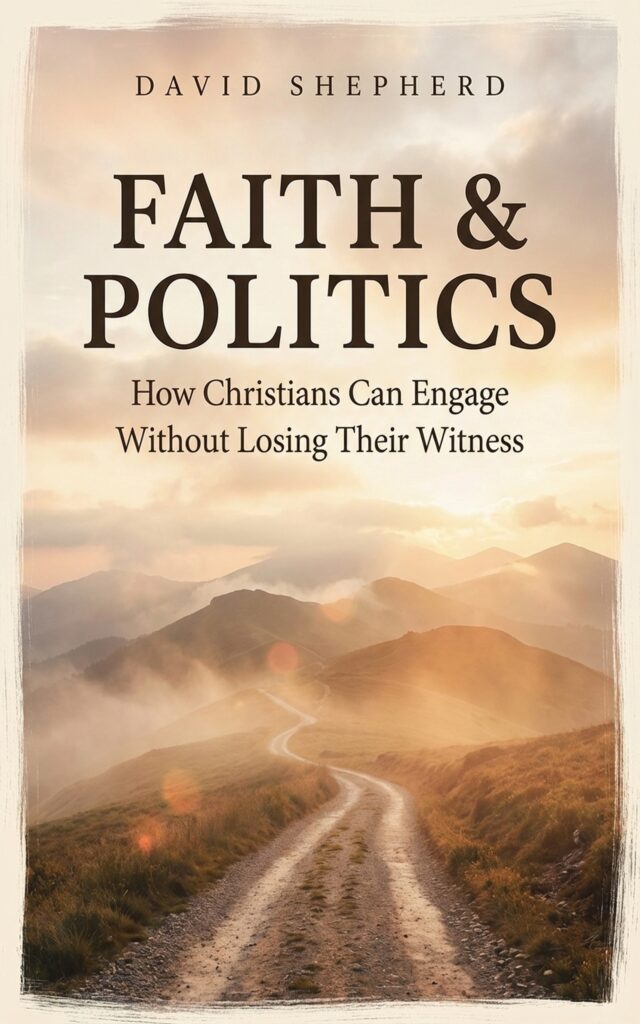
Be the first to review “Faith & Politics: How Christians Can Engage Without Losing Their Witness” Cancel reply
Faith is not separate from real life. It shapes how we work, love, parent, rest, and face uncertainty. This book brings biblical wisdom into everyday situations and offers practical guidance for living with purpose and grace in a complicated world.
The material is written for Christians who want more than inspiration. It combines Scripture, reflection, and actionable insight to help you grow in faith where it actually matters: your relationships, your work, your mind, and your habits. The tone is honest and grounded, acknowledging that following Jesus is both joyful and challenging.
Each section is designed to move you from understanding to practice. You will find biblical foundations, real-life application, and encouragement to take the next step. Whether you are reading on your own, with a small group, or as part of a devotional rhythm, this book meets you where you are.
If you are looking for a resource that respects your intelligence, speaks to your real struggles, and points you back to Christ, this book is a worthwhile companion. It does not promise easy answers, but it does offer truth that holds up under pressure.
Not sure yet? Here is the full table of contents and the first chapter, exactly as it appears in the book.
20 chapters in the complete book.
Let me start with a scene that might feel uncomfortably familiar.
It’s Thanksgiving. The table is set, the turkey is carved, and for about twenty-three minutes everything is wonderful. Then someone (it’s always someone) mentions the election. Maybe it’s an offhand comment about a news story. Maybe it’s a bumper sticker spotted on the drive over that someone just had to bring up. Whatever the trigger, you can feel the air change. Shoulders tighten. Eyes dart across the table. Your aunt, who sat next to you in the church pew just last Sunday and shared a hymnal with you, is now staring at your uncle like he just suggested burning the Constitution. And you, sitting somewhere in the middle, are trying to figure out whether to speak up, change the subject, or simply excuse yourself to check on the pie.
That scene, in all its awkward, painful, and sometimes darkly comic detail, is why I wrote this book.
Because the Thanksgiving table is just one of the places where faith and politics collide in ways that leave Christians feeling confused about what to do. There’s the church lobby on a Sunday morning, where two people you deeply respect are having a heated argument about a candidate while the worship team is still singing. There’s your small group chat, which used to be a place for prayer requests and now requires you to scroll past three political memes before you get to someone asking for prayer for their sick mother. There’s the moment you sit down to vote, pen in hand, and realize you’re not entirely sure any of the names on that ballot represent what you actually believe, and yet you feel a profound sense of responsibility to mark something.
Politics has moved in. And it didn’t exactly knock before entering.
For many Christians, this invasion of political energy into the sacred spaces of faith and community has created a kind of chronic low-grade anxiety. You want to engage (you believe you should engage) but every time you do, something gets broken. A friendship frays. A family dinner turns tense. A church splits along fault lines that have nothing to do with theology and everything to do with party affiliation. Increasingly, thoughtful believers are asking a question that cuts to the heart of the matter: Is it possible to participate meaningfully in political life without losing what makes us distinctively Christian in the first place?
That is the central question of this book. I want to be honest with you from the start: it doesn’t have a simple answer. But it does have a real one, and finding it is worth the work.
The Pressure to Choose a Team
One of the defining features of our current political moment is the relentless pressure to belong. Partisan culture doesn’t just want your vote; it wants your identity. It wants you to see the world through its lens, share its outrage, celebrate its victories, and despise its enemies. And it will reward you handsomely for compliance, with community, with certainty, with the intoxicating feeling that you are on the right side of history.
For Christians, this pressure arrives with extra force because it often comes wrapped in religious language. Political movements on both ends of the spectrum have become remarkably skilled at co-opting the vocabulary of faith (speaking of justice, righteousness, covenant, and calling) to recruit believers into partisan projects. The result is that many Christians don’t feel like they’re choosing a political party so much as they feel like they’re choosing faithfulness itself. To vote the other way, to express any sympathy for the other side, is framed not merely as a political disagreement but as a spiritual failure.
This is a trap, and we need to name it clearly before we go any further.
The apostle Paul, writing to a church that existed inside one of history’s most politically charged empires, made a striking claim: our citizenship is in heaven (Philippians 3:20). He wasn’t telling the Philippians to disengage from civic life, in fact, he used his own Roman citizenship strategically more than once. But he was insisting that their deepest identity, their most fundamental loyalty, their truest community, could not be colonized by any earthly political power. The Roman emperor could have Paul’s compliance on certain civic matters. He could never have Paul’s soul.
We live in a different empire, but the challenge is structurally identical. The question is whether we believe it enough to act like it.
What Has Politics Done to the Church?
Before we talk about how Christians should engage with politics, it’s worth pausing to be honest about what political engagement (done poorly) has already cost us.
Research by organizations like the Public Religion Research Institute and the Barna Group has consistently documented a troubling trend over the past two decades: large numbers of people, particularly younger adults, are leaving the church, and their reasons frequently include the church’s perceived political entanglement. They don’t just mean that the church has political opinions, most institutions do. They mean something more specific: that the church feels like an arm of a political party, that its moral concerns seem selectively applied based on partisan convenience, and that the Jesus they encounter in Scripture seems rather different from the one celebrated on Sunday morning when an election is near.
This is a witness crisis. And it demands our attention.
Now, I want to be careful here, because the solution is not to push Christianity into a kind of politically neutered silence. The prophets were not silent. Jesus was not apolitical. The early church, simply by declaring that Jesus (not Caesar) is Lord, was making one of the most politically charged statements imaginable. A Christianity that has nothing to say about justice, poverty, the vulnerable, or the exercise of power is not a faithful Christianity; it is a domesticated one.
But there is a world of difference between a faith that speaks prophetically from its own convictions and a faith that has been recruited as a foot soldier for someone else’s political agenda. The first is salt and light. The second is something far less interesting, and far less useful to the kingdom of God.
The Social Media Scroll and the Outrage Machine
Let me add one more scene to the ones I opened with, because I think it might be the most important one for our current moment.
You’re lying in bed, or sitting at a red light, or waiting for the coffee to brew, and you pick up your phone. Within thirty seconds of opening an app (it doesn’t much matter which one) you’ve encountered something that makes your blood pressure rise. A post from someone you follow, sharing something about a politician you can’t stand. A clip from a news segment that perfectly encapsulates everything you think is wrong with the country. A meme that reduces a complex issue to a punchline, shared gleefully by people you thought you knew better.
Before you’ve finished your first cup of coffee, you are already sorting the world into the righteous and the wicked. Already, somewhere in the back of your mind, composing a response. Already a little bit angrier, a little bit more convinced that the other side is not just wrong but dangerous, a little bit more certain that the people who disagree with you could not possibly be acting in good faith.
The architects of our social media ecosystem did not design these platforms to make us more thoughtful, more compassionate, or more fair. They designed them to keep us engaged, and the single most reliable way to keep human beings engaged is to keep them emotionally activated. Outrage, it turns out, is extraordinarily clickable. Fear is even better. And contempt (that particular flavor of disdain we feel toward people we believe to be not just wrong but morally beneath us) generates more engagement than almost anything else.
Christians are not immune to this. We are scrolling through the same feeds, feeling the same dopamine hits, developing the same reflexes. The spiritual cost is real. It is very difficult to love your neighbor as yourself while simultaneously spending forty-five minutes a day consuming content specifically designed to make you see that neighbor as a threat.
I raise this not to be alarmist, but because I think it explains a lot of the confusion Christians feel about political life. We wonder why our engagement so often feels un-Christlike. Part of the answer is that we are being formed, hour by hour, by systems that have no interest whatsoever in Christlikeness. The fruit we produce in our political lives reflects the soil we’ve been planted in, and for many of us, that soil has become deeply polluted.
A Different Way Is Possible
This book is not a lament. It is not a call to retreat from the public square. And it is most certainly not a claim that one political party is more Christian than the other, I have no interest in writing that book, and I don’t think it would be true anyway.
At its core, this is a practical theology of political engagement for ordinary Christians who want to do it well. It is built on the conviction that faith and politics can coexist without one devouring the other, but only if we are intentional, rooted, and honest about what we’re doing and why.
Over the chapters ahead, we’ll cover a lot of ground together. We’ll look at what Scripture actually says about government, power, and civic life, and some of it will surprise you, because the Bible’s political vision is far more textured and complex than most partisan readings allow. We’ll examine the history of Christians in the public square, including some inspiring examples and some cautionary tales that should give us pause. We’ll think carefully about specific issues (poverty, immigration, life, religious liberty, racial justice) and what faithfulness looks like when you’re trying to vote or advocate on something complicated.
We’ll also spend significant time on the relational and spiritual dimensions of political engagement: how to talk across deep disagreements, how to maintain friendships with people who see things differently, how to protect your church community from the fractures that partisan politics loves to exploit, and how to guard your own heart against the bitterness and tribalism that political life can so easily cultivate.
Through all of it, the question we’ll keep returning to is this: What does it look like for a Christian to engage politically in a way that actually looks like Jesus?
A Word About Tone
Before we go any further, I want to say something about the spirit in which I’ve tried to write this book, because tone matters as much as content when it comes to political conversation among Christians.
I am not writing as someone who has this all figured out. I have made plenty of mistakes in my own political engagement, said things I regretted, held positions with more certainty than the evidence warranted, let partisan loyalty crowd out prophetic clarity at moments when clarity was needed. I write as a fellow pilgrim, not a professor grading papers.
I also write with genuine affection for Christians across a wide spectrum of political conviction. I know deeply committed followers of Jesus who vote very differently from each other, whose political differences reflect real and sincere wrestling with Scripture, conscience, and the complexities of the world we share. My goal is not to adjudicate those differences or nudge you toward one party or another. My goal is to help you engage whatever convictions you hold with more faithfulness, more grace, and more genuine love for the people around you, including the ones who see things very differently.
At the same time, I want to be honest. Some ways of engaging politically are more faithful than others. Certain values (the dignity of every human being, the call to pursue justice for the vulnerable, the refusal to treat political opponents as subhuman) are non-negotiable for anyone who claims to follow Jesus. Where those convictions surface in the pages ahead, I’ll name them clearly. I owe you that honesty.
What I won’t do is pretend that faithfulness maps neatly onto any party platform, or that the Christian vote belongs to anyone. It doesn’t. It belongs to each believer before God, informed by Scripture, shaped by community, and offered with humility in recognition that we see through a glass darkly.
The Stakes Are High, But Not the Way You Might Think
Here is something I want to propose early and return to often: the stakes of how Christians engage politically are high, but perhaps not primarily for the reasons political culture wants us to think.
Political culture tells us the stakes are high because the fate of the nation hangs in the balance. There is something true in that, policies matter, elections have consequences, and the decisions made by governments affect real people’s lives. I don’t want to minimize that.
But as I read the New Testament, I find a community living under an empire it had essentially no power to change, whose members nonetheless believed they were participating in something of world-historical significance. Not because they were going to take over the Roman Senate, but because the community they were building, the love they were practicing, the cross-shaped alternative society they were embodying, was a sign to the watching world of what the kingdom of God actually looked like.
The stakes for Christians in political engagement are high because our witness is at stake. The question is not merely whether we vote for the right candidate or advocate for the right policy. The question is whether, in the middle of one of the most divisive eras in recent memory, the church of Jesus Christ looks like something different, hopeful, loving, oriented toward a kingdom that no election can bring in and no election can take away.
That is what I believe is possible. That is what I am inviting you to pursue.
The Thanksgiving table will probably still get awkward. The church lobby conversations will still happen. The social media scroll will still tempt you toward despair or rage. But there is a way to move through all of it with your faith intact, your witness uncompromised, and your love for your neighbor (even your political opponent) stubbornly alive.
That way is not easy. But it is deeply worth finding. Let’s look for it together.
… and that is just the beginning. The complete book continues from here, instant download, DRM-free, yours to keep.





Reviews
There are no reviews yet.