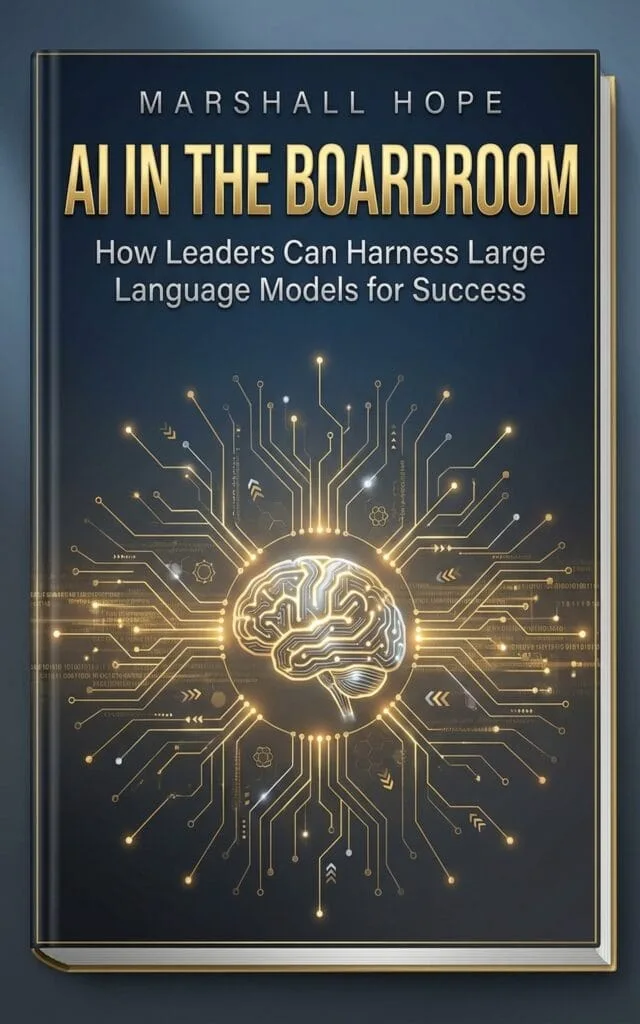
Be the first to review “AI in the Boardroom: How Leaders Can Harness Large Language Models for Success” Cancel reply
Artificial intelligence is reshaping how we work, lead, and make decisions. For many professionals, the challenge is not whether to use AI but how to use it well. This book gives you a clear, practical path through the noise so you can adopt AI tools confidently and responsibly.
The guidance is grounded in real workplace scenarios. You will see how AI can speed up research, improve communication, support analysis, and free up time for judgment-driven work. You will also learn where AI falls short and how to avoid the common mistakes that waste time or create risk.
This book is written for professionals who do not need another hype piece. It focuses on what actually works: better prompts, realistic implementation plans, thoughtful governance, and ethical boundaries. The goal is to make AI useful without making it irresponsible.
By the end, you will have a framework for evaluating AI tools, integrating them into your workflow, and leading others through the transition. That is a skill set that will matter for years to come.
Not sure yet? Here is the full table of contents and the first chapter, exactly as it appears in the book.
30 chapters in the complete book.
Somewhere in your industry right now, a competitor is having a conversation with an AI that your team is not having. That conversation might be about your customers, what they want, what frustrates them, what would make them switch. It might be about your supply chain, your pricing model, your regulatory exposure, or the product you haven’t built yet. That competitor may not be smarter than you. They may not have a bigger budget. But they have made a decision (a strategic, deliberate decision) to treat artificial intelligence as a core input to how they lead, and that decision is already compounding in their favor.
This is not a book about technology. It is a book about leadership. Specifically, it is about the leadership decisions that will determine which organizations thrive in the intelligence era and which ones look back in five years wondering exactly when they lost the plot. The technology itself (large language models, or LLMs) is real, it is here, and it is advancing faster than most executives have had time to absorb. But the technology is not your problem to solve. Your problem is strategic: how do you harness what AI makes possible, at the pace this moment demands, without losing the judgment and human accountability that make your organization worth leading in the first place?
Let’s start with some honest context, because the noise around AI has been extraordinary and not all of it has been helpful.
For the better part of the last decade, artificial intelligence was a phrase that mostly lived in the province of data scientists, research labs, and breathless conference keynotes. Executives nodded along. Innovation teams ran pilots. Boards asked questions, got reassured, and moved on to the next agenda item. The practical reality was that most enterprise AI projects were expensive, slow, narrow in their utility, and deeply dependent on specialized talent that was hard to find and harder to retain. The technology was impressive in the lab. In the wild, it was mostly incremental.
Then something changed.
In late 2022, large language models arrived in the hands of ordinary people in a form they could actually use. Not through a developer API. Not through a specialized workflow tool. Through a simple text box. You typed something in plain language and got a response that was (depending on the task) useful, surprising, occasionally wrong, and almost always faster than anything a human team could produce unaided. Within two months of its public release, ChatGPT had reached one hundred million users, a milestone that took Instagram two and a half years and TikTok nine months to reach. Nothing in the history of consumer technology had spread that fast.
But speed of adoption, while striking, is not the reason this matters to you as a leader. What matters is what large language models can actually do, and more importantly, what that capability means for the structure of competitive advantage in your industry.
To understand why this moment is different, it helps to look at the major technology transitions that preceded it. The internet, in the mid-1990s, fundamentally changed how information moved. Organizations that grasped this early (that saw the internet not as a website project but as a restructuring of how markets communicated) built advantages that proved durable. Those that treated it as a technology department initiative and waited for the implications to become obvious paid steep prices. Borders, Blockbuster, Kodak: the cautionary tales are well known, but the lesson drawn from them is usually too simple. These companies did not fail because they missed the technology. They failed because their leadership did not see the technology as a strategic question until it was too late to shape their response.
Mobile computing followed a similar arc. When the iPhone launched in 2007, it was easy to frame as a consumer device, a very good phone with a music player and a web browser. What it actually represented, as became clear within a few years, was a restructuring of where human attention lived and therefore where commercial relationships could be built. Organizations that understood early that mobile was a behavioral shift, not a screen-size shift, built platforms and products that dominated the following decade. Those that ported their desktop websites to smaller screens and called it a mobile strategy found themselves permanently behind.
Cloud computing, through Amazon Web Services and its competitors, restructured the economics of software infrastructure. What had required capital expenditure, physical hardware, and long procurement cycles became on-demand, variable-cost, infinitely scalable. This didn’t just change IT budgets, it changed who could build software at scale, which in turn changed competitive dynamics in virtually every industry. A startup that could rent computing infrastructure by the hour could suddenly compete with enterprises that had spent decades building proprietary systems. The barrier to entry collapsed, and it collapsed surprisingly fast.
Each of these transitions shared a common pattern: they began as technology stories, became business model stories, and ended as leadership stories. The organizations that won were not necessarily the ones that understood the technology first. They were the ones whose leaders recognized the strategic inflection point and reorganized their decision-making, their resources, and their priorities around it.
Large language models follow this pattern, but with a crucial difference: the speed and scope of implication are greater than anything we have seen before, and the consequences are not limited to one function or one industry. Every previous technology shift created new winners in specific domains, retail, media, logistics, financial services. AI is restructuring the economics of knowledge work itself, which means the implications touch every function in every organization of any meaningful scale.
Consider what a large language model actually is. At its core, it is a system trained on vast quantities of human-generated text that has learned to predict and generate language with remarkable coherence and contextual awareness. What makes this practically powerful is not the underlying mathematics (you do not need to understand transformer architecture any more than you need to understand internal combustion to drive a car) but what the capability enables. An LLM can read and synthesize a thousand pages of documents and surface the three findings that matter most to a specific decision. It can draft a first version of any written work (a strategy memo, a customer proposal, a regulatory filing, a board presentation) in seconds. It can hold a complex problem in context and help a leadership team stress-test assumptions, explore scenarios, and identify blind spots. It can converse in dozens of languages, adapt its tone to its audience, and learn from context you provide in real time.
None of this makes AI infallible. Large language models hallucinate, they generate plausible-sounding content that is factually wrong. They inherit biases from their training data. They lack genuine understanding in the philosophical sense, and they should never be given unsupervised authority over decisions that carry material consequences. These limitations are real and they matter, and we will spend meaningful time in later chapters understanding them well enough to manage them responsibly.
But the limitations do not change the fundamental calculus. A technology that makes knowledge workers dramatically more productive, that lowers the cost of high-quality written and analytical output by orders of magnitude, and that can be deployed across an organization within months rather than years is a strategic variable no serious leader can afford to treat as optional, imperfections and all.
The organizations already acting on this reality span industries and geographies. Morgan Stanley deployed a large language model to give its financial advisors instant access to the firm’s entire research library (decades of analyst reports, product documentation, and compliance guidance) through a simple conversational interface. Advisors who previously spent significant time searching for information could now spend that time with clients. Moderna has integrated AI into its research workflows so deeply that the company has described it as a fundamental enabler of its ambition to develop more drugs faster. Law firms are using LLMs to review and summarize contracts in minutes that previously took lawyers hours. Marketing teams are using them to produce localized content at a scale that would have required entire departments. Retailers are using them to analyze customer feedback across thousands of reviews and surface actionable product insights in real time.
In every case, the pattern is the same: tasks that previously required expensive human time, specialized expertise, or both are being executed faster, cheaper, and at greater scale. The competitive implication is not subtle. If your competitor can analyze customer sentiment across five hundred thousand data points in an afternoon and you are doing it manually across a sample of five hundred, they are not just more efficient, they are making better decisions, faster, with more confidence. That gap compounds.
Equally instructive are the organizations falling behind, often without fully realizing it yet. These are not the obvious laggards, companies actively resisting AI out of fear or ideology. Those are relatively rare. The more common failure mode is something more insidious: organizations running AI experiments in isolated pockets, treating deployment as a technology project rather than a strategic initiative, waiting for clearer evidence before committing leadership attention at the top. These organizations are not inactive. They are simply operating at a pace, and with a level of executive engagement, that is meaningfully slower than what the moment demands. The cost of that gap rarely shows up in quarterly results yet. But it is accumulating.
The reason this book insists on framing AI as a boardroom imperative (not a department initiative) comes down to a simple observation: meaningful AI integration requires decisions that only senior leadership can make. Where to invest and where to hold back. Honest assessment of the organization’s data infrastructure, its talent profile, its risk tolerance, its competitive position. Governance structures that manage the real risks of AI deployment without strangling the real opportunity. And a cultural signal from the top that this is serious, sustained, and strategically important, not a science project. None of these decisions can be delegated down. They belong in the room where your most consequential strategic choices are made.
This book is organized to take you through that journey systematically. The early chapters ground you in how large language models actually work, not technically, but conceptually, well enough to ask sharp questions and evaluate what you are being told. The middle chapters move into strategy and operations: how to identify the highest-value use cases in your organization, how to build for scale rather than just pilots, how to manage the data and governance requirements that serious deployment demands. The later chapters address the harder questions of leadership, how to build an AI-capable culture, how to navigate the ethical dimensions of deployment responsibly, how to communicate your AI strategy to your board, your investors, and your people, and how to sustain the organizational momentum this transformation requires over a multi-year horizon.
Each chapter is designed to be directly actionable. The goal is not to educate you about AI in the abstract but to give you the frameworks, the language, and the judgment to make better decisions in your specific context. You do not need to become a technologist. You need to become a leader who can harness what technologists have built, one who asks the right questions, sets the right direction, and holds the organization accountable for outcomes that matter.
One thing is worth saying plainly before we go further, because it shapes how this entire book should be read. The intelligence revolution is not coming. It is not approaching on the horizon, not five years away, waiting for the technology to mature or the regulatory environment to settle. It is happening now, in real organizations, in real markets, with real competitive consequences. The leaders and companies that treat this as an urgent present-tense reality (not a future-state planning exercise) are the ones that will look back on this period as a moment of decisive advantage-building.
The ones that wait for certainty before committing will find that the certainty they were waiting for arrives in the form of a competitor who didn’t wait.
You are reading this book because you understand, at some level, that the stakes are real. Every chapter that follows is an invitation to turn that understanding into action. Let’s get to work.
… and that is just the beginning. The complete book continues from here, instant download, DRM-free, yours to keep.




Reviews
There are no reviews yet.