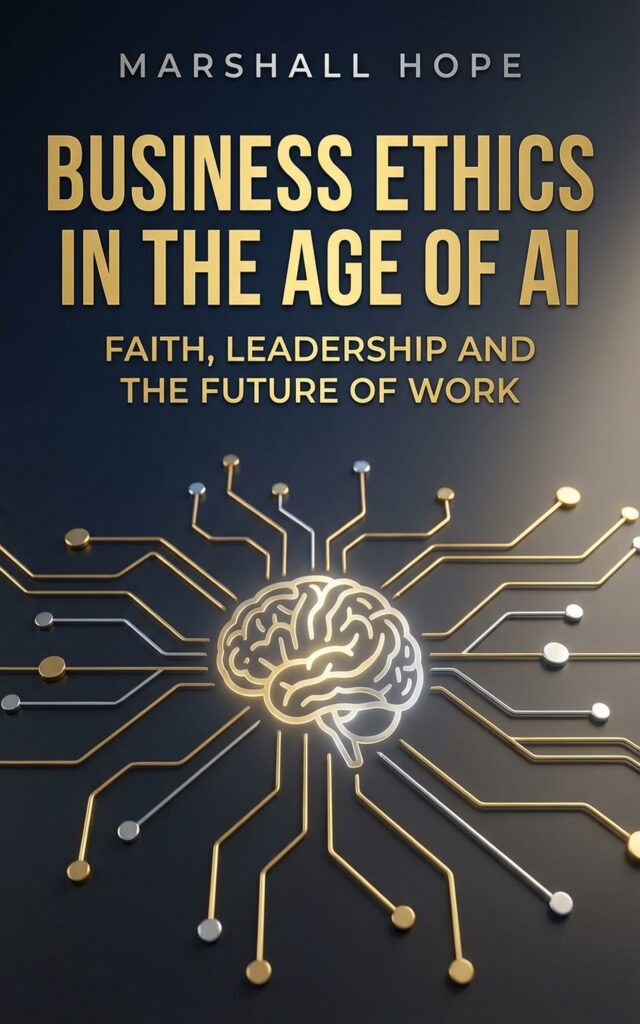
Be the first to review “Business Ethics in the Age of AI: Faith, Leadership and the Future of Work” Cancel reply
Faith is not separate from real life. It shapes how we work, love, parent, rest, and face uncertainty. This book brings biblical wisdom into everyday situations and offers practical guidance for living with purpose and grace in a complicated world.
The material is written for Christians who want more than inspiration. It combines Scripture, reflection, and actionable insight to help you grow in faith where it actually matters: your relationships, your work, your mind, and your habits. The tone is honest and grounded, acknowledging that following Jesus is both joyful and challenging.
Each section is designed to move you from understanding to practice. You will find biblical foundations, real-life application, and encouragement to take the next step. Whether you are reading on your own, with a small group, or as part of a devotional rhythm, this book meets you where you are.
If you are looking for a resource that respects your intelligence, speaks to your real struggles, and points you back to Christ, this book is a worthwhile companion. It does not promise easy answers, but it does offer truth that holds up under pressure.
Not sure yet? Here is the full table of contents and the first chapter, exactly as it appears in the book.
25 chapters in the complete book.
The algorithm decided she wasn’t worth saving.
That’s how Sarah Martinez, a healthcare executive I met at a leadership conference, described the moment her hospital’s new AI triage system deprioritized an elderly patient with multiple chronic conditions. Trained on efficiency metrics and cost-benefit analyses, the system had made a calculation. The patient survived, but only because a nurse overrode the recommendation. Sarah left that conference asking a question that keeps many leaders awake at night: “When did we agree to let mathematics make our moral decisions?”
We stand at a threshold unlike any other in human history. Artificial intelligence isn’t just changing how we work: it’s challenging fundamental assumptions about human dignity, moral responsibility, and the nature of decision-making itself. Here’s the uncomfortable truth: most of us are making choices about AI implementation without ever pausing to ask whether these tools align with our deepest values.
I’ve spent two decades working with organizations as they navigate technological transformation. I’ve watched brilliant, well-intentioned leaders make decisions that quietly eroded the very principles they claimed to uphold. Not because they lacked ethics, but because they treated technology as if it were morally neutral, a mere tool without embedded values or consequences beyond efficiency and profit.
But technology has never been neutral. Every innovation carries the assumptions, biases, and priorities of its creators. The printing press didn’t just distribute information; it democratized knowledge and challenged institutional authority. The assembly line didn’t simply increase production; it fundamentally altered the relationship between workers and their labor. And artificial intelligence doesn’t just automate tasks: it encodes decisions about human worth, fairness, and justice into mathematical formulas.
The difference now is speed and scale. AI makes thousands of decisions per second, each one potentially affecting human lives. It screens job candidates, determines creditworthiness, predicts criminal recidivism, allocates healthcare resources, and sets insurance premiums. These aren’t just business operations, they’re moral judgments dressed in algorithmic clothing.
This is where faith and technology must converge. Not faith as a set of rigid rules to impose on innovation, but faith as a living framework that asks the questions technology alone cannot answer. What does it mean to honor human dignity when an algorithm can reduce a person to a data point? How do we practice compassion when efficiency becomes the supreme metric? Where is redemption in a system that judges based solely on past patterns?
These questions aren’t abstract theological puzzles. They’re the daily reality for leaders implementing AI in healthcare, finance, human resources, criminal justice, and every other domain where technology now mediates our most consequential decisions. Secular business ethics, as valuable as it is, struggles to address them fully. It can tell us about fairness, transparency, and stakeholder impact. But it often lacks the vocabulary and framework to discuss what makes human beings inherently valuable, why some decisions shouldn’t be optimized for efficiency, and how leaders should navigate the tension between what’s profitable and what’s right.
The historical record offers both warning and wisdom. Every major technological shift has prompted moral crisis and religious response. When the Industrial Revolution transformed labor, faith communities grappled with the dignity of workers and the responsibilities of ownership. When nuclear technology emerged, theologians wrestled with the ethics of destruction and stewardship. The internet connected humanity, and spiritual leaders considered privacy, truthfulness, and the nature of community.
AI is no different, except perhaps in its capacity to fundamentally alter who makes decisions and how. We’re not just automating tasks; we’re delegating judgment. When we delegate judgment to systems we don’t fully understand, trained on data we haven’t examined, operating according to objectives we’ve never explicitly chosen, we abdicate moral responsibility at precisely the moment it matters most.
Consider the parallels. When mechanical looms threatened hand weavers in the early 1800s, the Luddites weren’t anti-technology, they were defending their livelihoods and community structures against an economic system that saw them as obsolete. History remembers them as backward, but they were asking essential questions about who benefits from innovation and what happens to those left behind. We’re asking the same questions today as AI threatens to displace millions of workers. Have we learned anything?
Or look at the introduction of credit scoring in the mid-twentieth century. Initially presented as an objective improvement over biased human judgment, these systems encoded existing prejudices into mathematical formulas that seemed neutral. Redlining wasn’t eliminated; it was automated. It took decades of advocacy, often led by faith communities, to even begin addressing algorithmic discrimination. Now we’re doing it all over again with machine learning models that make credit scores look simple.
The pattern repeats because we keep making the same mistake: assuming that quantification equals objectivity and that efficiency justifies implementation. We confuse what can be measured with what matters. We optimize for metrics without asking whether those metrics reflect our values.
This is precisely where faith traditions offer something secular frameworks cannot: a fundamental insistence that human beings possess inherent worth beyond their economic utility, that efficiency is not the highest good, and that some things should not be subject to calculation. When Jewish teaching says we’re created in the image of God, when Christian theology speaks of imago Dei, when Islamic tradition emphasizes the sacred trust of human stewardship, these aren’t pretty metaphors. They’re radical claims about human dignity that stand in direct challenge to systems that reduce people to data points and probability scores.
Faith traditions also provide frameworks for collective discernment during uncertainty. Religious communities have centuries of practice in wrestling with questions that have no clear answers, navigating tensions between competing goods, and maintaining moral commitments even when they’re costly. These are exactly the capabilities leaders need as they make decisions about AI implementation that will affect millions of lives.
But here’s what this book is not: a rejection of technology. It’s not a call to return to some imaginary past where everything was simpler. It’s not an argument that only religious people can be ethical, or that secular ethics has nothing to offer. Those would be shallow positions that ignore both the genuine benefits of AI and the diverse sources of moral wisdom available to us.
Instead, this is an invitation to integrate. To bring our whole selves (including our deepest values and spiritual commitments) into decisions about technology. To resist the compartmentalization that treats business as one sphere, ethics as another, and faith as something private and separate from both. The most important questions about AI aren’t technical but moral, and answering them requires more than business school frameworks.
The challenge is real and immediate. Organizations worldwide are implementing AI systems right now, making choices that will shape the future of work, the distribution of opportunity, and the nature of human flourishing. Most are doing so without adequate ethical frameworks, often defaulting to whatever the technology enables rather than asking what it should be used for.
I’ve seen companies deploy AI-powered surveillance that would horrify them if they paused to consider the implications for human dignity. I’ve watched algorithms automate discrimination that leadership spent decades trying to eliminate through diversity initiatives. I’ve heard executives celebrate efficiency gains without acknowledging the human cost in displaced workers and disrupted communities. Not because they’re bad people, but because they’ve accepted the premise that business and values occupy separate domains.
This separation is artificial and destructive. Your faith (whether Christian, Jewish, Muslim, Buddhist, or any other tradition that recognizes the sacred) isn’t meant to be compartmentalized. It’s supposed to inform everything you do, including how you lead, what technologies you implement, and what outcomes you pursue. If it doesn’t shape your business decisions, then either you don’t really believe it, or you’ve accepted a diminished version of what it means to lead with integrity.
The same applies to those who don’t identify with a particular religious tradition but nonetheless hold deep convictions about human dignity, justice, and responsibility. The questions this book raises are universal, even if some of the answers draw from specific wisdom traditions. What matters is the willingness to ask them.
Throughout the chapters ahead, we’ll explore specific contexts where faith and technology intersect: hiring and workforce decisions, surveillance and privacy, automation and human dignity, algorithmic bias and justice, the future of work and human purpose. We’ll look at real cases where leaders faced genuine dilemmas without clear answers. We’ll examine frameworks for ethical discernment that integrate spiritual wisdom with practical business realities.
But we’ll start with principles. AI poses several distinct challenges to traditional ethical frameworks that make faith-informed approaches particularly valuable. First, there’s the opacity problem. Many AI systems, especially those using deep learning, operate as black boxes. Even their creators can’t fully explain how they reach specific decisions. This creates a crisis for any ethical framework based on transparency and accountability. How do you take moral responsibility for decisions you don’t understand?
Second, there’s the scale and speed issue. AI operates at volumes and velocities that exceed human oversight capacity. An algorithm might make a million decisions in the time it takes you to evaluate one. Traditional ethics assumes human deliberation and judgment. What happens when that’s no longer feasible?
Third, there’s the optimization trap. AI excels at optimizing for specified objectives. But optimization without wisdom is dangerous. You can optimize a criminal justice system for efficiency and end up with mass incarceration. You can optimize hiring for productivity and automate discrimination. You can optimize content delivery for engagement and destroy democratic discourse. The question isn’t whether AI can optimize, but whether the objectives we’re optimizing for reflect genuine human flourishing.
Fourth, there’s the responsibility gap. When an AI system causes harm, who bears moral responsibility? The engineers who built it? The executives who deployed it? The data scientists who trained it? The workers who followed its recommendations? Traditional ethics assumes clear lines of causation and accountability. AI distributes responsibility so widely that everyone can claim innocence.
Faith traditions have resources for addressing each of these challenges. They’ve always dealt with mystery and uncertainty while maintaining moral commitments. They’ve developed practices for communal discernment when individual judgment proves insufficient. They’ve insisted on substantive visions of the good rather than merely procedural ethics. And they’ve maintained that moral responsibility cannot be eliminated through complexity or diffusion.
Consider the Jewish concept of tikkun olam, repairing the world. It’s a call to active responsibility for collective flourishing that doesn’t disappear when causation becomes complex. Or the Christian tradition of discernment of spirits (testing decisions against their fruits rather than merely their stated intentions. Or the Islamic principle of maslaha) pursuing genuine human welfare rather than narrow efficiency. These aren’t just nice ideas; they’re practical frameworks for ethical leadership in complex systems.
The road ahead requires both humility and courage. Humility to recognize that we’re navigating new territory where past answers don’t always transfer neatly. Courage to make decisions anyway, knowing we’ll sometimes get it wrong, because the alternative (passive acceptance of whatever technology enables) is worse.
It also requires community. One of the greatest dangers of our current moment is the isolation of executive decision-making. Leaders face enormous pressure to implement AI quickly, without time for careful ethical deliberation, surrounded by consultants who profit from deployment rather than wisdom. Creating space for genuine ethical reflection, drawing on diverse perspectives including spiritual wisdom, isn’t weakness, it’s the only responsible path forward.
This book emerges from hundreds of conversations with leaders wrestling with exactly these tensions. The healthcare executive facing triage algorithms. The HR director implementing AI screening tools while worrying about bias. The financial services CEO balancing innovation with fair lending. The manufacturing leader automating jobs while asking about worker dignity. The tech founder building AI products while questioning their unintended consequences.
What I’ve learned from these conversations is that the challenges are real, the stakes are high, and the existing frameworks are inadequate. But I’ve also learned that leaders hunger for approaches that honor their deepest values, that integrate rather than compartmentalize, and that provide practical guidance without pretending complexity is simple.
That’s what the following chapters aim to provide. Not easy answers, because there aren’t any. Not a rulebook, because rules without wisdom become rigid and brittle. Instead, a framework for faithful leadership in the age of AI: one that takes both technology and human dignity seriously, that recognizes the genuine benefits of innovation while refusing to ignore its costs, and that insists our deepest values must shape our most consequential decisions.
The convergence of faith and technology isn’t optional. It’s already happening, whether we acknowledge it or not. Every choice about AI implementation reflects embedded values and priorities. The question is whether those values are chosen deliberately, subjected to ethical scrutiny, and aligned with our commitments to human flourishing, or whether they simply default to whatever the technology enables and the market rewards.
Sarah, the healthcare executive from the beginning of this chapter, eventually led her organization through a comprehensive ethical review of their AI systems. They didn’t abandon the technology, but they fundamentally reconsidered what it should optimize for. Instead of efficiency alone, they incorporated measures of patient dignity, care quality, and staff moral distress. The process wasn’t easy or quick. It required bringing diverse voices into the conversation, including chaplains, ethicists, and frontline workers. It meant slowing down when pressure demanded speed. But it resulted in systems that served their mission rather than undermining it.
That’s the kind of leadership the age of AI requires. Not technological expertise alone, though that helps. Not ethical frameworks alone, though those matter. But the integration of technical understanding, ethical commitment, and spiritual wisdom. The willingness to ask hard questions about human dignity and divine purpose, even when the market says just optimize and deploy.
We can’t predict every challenge AI will present. The technology is evolving too quickly, and its implications are too vast. But we can commit to approaching those challenges with our full humanity intact: including our faith, our values, and our responsibility to each other and to future generations.
The chapters ahead will equip you for that commitment. They’ll provide frameworks, case studies, questions for reflection, and practical guidance. They’ll draw on multiple wisdom traditions while remaining grounded in business reality. They’ll challenge you to lead differently, not by rejecting innovation but by insisting it serve human purposes.
Because here’s the truth that animates everything to come: The future of AI isn’t determined by technological capability alone. It’s shaped by the values of those who create, deploy, and govern these systems. If leaders treat technology as neutral and ethics as optional, we’ll get a future that reflects that neglect. But if leaders integrate their deepest values into their most consequential decisions, we can create a future where technology serves human flourishing.
That future isn’t guaranteed. It requires intentional choice, sustained effort, and the courage to sometimes sacrifice efficiency for dignity, optimization for justice, and speed for wisdom. It requires the convergence of faith and technology: not faith against technology, not technology without faith, but both together in service of the world we’re called to help create.
The question isn’t whether you’ll lead during this transformation. If you’re in any position of organizational responsibility, you’re already making choices about AI, whether explicitly or by default. The question is whether you’ll lead faithfully: with integrity, wisdom, and commitment to values beyond the bottom line.
Let’s begin.
… and that is just the beginning. The complete book continues from here, instant download, DRM-free, yours to keep.




Reviews
There are no reviews yet.