Be the first to review “The House on Dunehaven Lane” Cancel reply
Romance
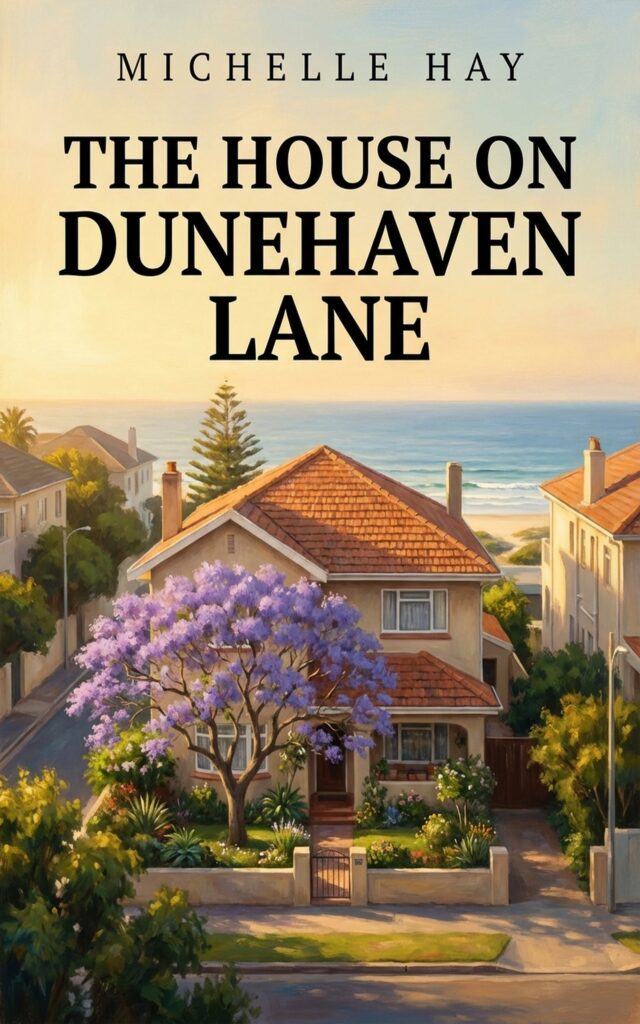
The House on Dunehaven Lane
by Michelle Hay
$9.99
About This Book
When Naomi Price inherits her grandmother Clara’s house on Dunehaven Lane in a sleepy South African coastal town, she expects nothing more than a property to sell and a final tie to a past she’s spent years trying to forget. Instead, she discovers the house harbors decades of secrets: a hidden room built into the pantry, journals filled with her grandmother’s private thoughts, and evidence of a life lived at the intersection of love and resistance. Clara Wilkins, a white woman married to a police sergeant during South Africa’s apartheid era, defied the system by sheltering activists on the run. Among them was Thabo Molefe, a brilliant young freedom fighter who became the great love of her life. Their relationship (transcending every boundary the state had erected) lasted only eight months before Thabo disappeared into the machinery of detention. He was never seen again. As Naomi reads through Clara’s journals and uncovers hidden photographs, she begins to understand the cost of her grandmother’s choices: the violence endured, the risks taken, the decades of silence that followed. She teams up with Daniel Botha, a historian researching the anti-apartheid networks of the region, to piece together the truth about what happened to Thabo and why someone seems determined to bury this history once and for all. But the more Naomi digs, the more dangerous the past becomes. Someone knows she’s asking questions. Someone is searching for the same evidence. And somewhere in the archives of a ruthless system lies the answer to what price Clara paid for her choice to love across the color line. In a house that remembers everything, Naomi must decide whether the truth is worth protecting, even if it destroys the fragile family legacy she’s only just beginning to understand.
Read a Sample ▸
Not sure yet? Here is the full table of contents and the first chapter, exactly as it appears in the book.
Contents
- Chapter 1: The Inheritance Nobody Wanted
- Chapter 2: Arriving at the Edge of Memory
- Chapter 3: The First Journal’s Voice
- Chapter 4: Echoes in the Walls
- Chapter 5: The Name in the Margin
- Chapter 6: The Photograph in the Floorboards
- Chapter 7: What the Archives Remember
- Chapter 8: Fractures in the Foundation
- Chapter 9: Lindiwe’s Story
- Chapter 10: Letters from the Dead
- Chapter 11: The Man Who Watches
- Chapter 12: Her Mother’s Silence
- Chapter 13: What Was Buried
- Chapter 14: The Dangerous Truth
- Chapter 15: The Cost of Speaking
- Chapter 16: Ghosts and Witnesses
- Chapter 17: The Informant’s Reckoning
- Chapter 18: Choosing to Stay
- Chapter 19: The House Breathes Again
- Chapter 20: What We Inherit
20 chapters in the complete book.
Chapter 1: The Inheritance Nobody Wanted
The envelope arrived on a Thursday, wedged between a glossy sale advert sheet and a takeaway menu I’d never asked for. I almost threw it out with junk mail. Almost.
Something about the weight of it stopped me. Heavy cream paper, the kind nobody uses anymore. My name typed across the front in a formal font that belonged to another era: Ms. Naomi Price. No return address, just a Durban postmark and a law firm’s name embossed in the corner.
I stood in the narrow hallway of my Johannesburg flat, afternoon sun slanting through dusty windows, and felt unease crawl up my spine.
I tore it open.
Dear Ms. Price, It is with regret that we inform you of the passing of Mrs. Clara Wilkins on the 14th of January. As the executor of her estate, I am writing to notify you that you have been named as the sole beneficiary of her Last Will and Testament…
The words blurred. I read them three times before they settled into something like meaning.
Clara was dead.
My grandmother—a woman I barely knew, who’d become more myth than memory over the past twenty-four years—was gone. And apparently, she’d left me something.
I sank onto the arm of my secondhand couch, the letter trembling in my hands. I couldn’t decide what I felt. Grief seemed too generous a word for the hollow ache spreading through my chest. Relief, maybe. Or guilt. Or that strange cocktail of emotions reserved for people who exit your life long before they stop breathing.
The letter continued in its careful, legal language. There was a house. The one on Dunehaven Lane, in a coastal town, Amanzi Haven, near the Umdloti River in KwaZulu Natal. I remembered it in fragments: whitewashed walls, a tangled garden, the smell of salt and something sweeter. Frangipani, maybe. But those memories were thin, worn smooth by time and distance.
Then I reached the condition.
In accordance with Mrs. Wilkins’ wishes, ownership of the property at 17 Dunehaven Lane will transfer to you in full upon completion of a six-month residency period. Failure to meet this requirement will result in the property being sold, with proceeds donated to the Community Trust.
I read it again. Then a third time.
Six months. She wanted me to live there for six months.
I laughed—a sharp, bitter sound that echoed in the empty flat. Of course she did. Even from the grave, Clara Wilkins was making demands, pulling strings, trying to control things she had no right to touch.
I crumpled the letter in my fist, then smoothed it out again. My hands were shaking.
I hadn’t thought about Dunehaven Lane in years. I’d worked hard not to.
* * *
The flat felt smaller after that. Claustrophobic. I paced from the kitchen to the bedroom and back, three steps in each direction, my thoughts spiraling.
My phone buzzed on the counter. I ignored it. Probably my editor, wondering where my overdue piece was. Or my landlord, reminding me that rent was due again. Or maybe Ryan, my ex, texting from whatever new life he’d built without me.
I’d stopped answering his calls weeks ago.
My life in Johannesburg had unraveled so gradually I hadn’t noticed it happening until I was standing in the wreckage. The journalism career I’d fought for had stalled somewhere between budget cuts and burnout. The relationship I’d thought might anchor me had ended in a fight so quiet it barely made a sound—just Ryan packing his things while I sat at the kitchen table, too tired to argue.
Now I spent my days pitching articles that never sold, eating two-minute noodles for dinner, and pretending I had a plan.
I didn’t have a plan.
I had thirty-two thousand rand in debt, a lease that ends soon, and a growing suspicion that I’d made a series of catastrophically bad decisions.
And now this. A house I didn’t want. A grandmother I’d never understood. A condition that felt like a trap.
I pulled out my laptop and typed Amanzi Haven into the search bar. Images loaded slowly: a sleepy coastal town, whitewashed buildings clustered along a curve of blue water, jacaranda trees lining quiet streets. Exactly as I remembered it—small, provincial, suffocating.
I’d left when I was nine, after my mother’s fight with Clara fractured the family so completely we never went back. I didn’t know the details. My mother refused to talk about it, even now and by the time I was old enough to ask the right questions, it didn’t seem worth it.
And now Clara was dead, and somehow that unfinished anger felt heavier than grief.
* * *
I called the lawyer the next morning. His name was Mr. Gopal, and his voice was kind in a professional, detached way.
“I understand this must be difficult,” he said after I’d explained who I was. “Your grandmother was quite clear about her wishes, though I’ll admit the condition is unusual.”
“Unusual,” I repeated. “That’s one word for it.”
“The house has been unoccupied for few months when Mrs. Wilkins moved into a care facility, and after her passing, we’ve been managing the property. It’s in reasonable condition, though it will need some attention.”
“And if I don’t stay? If I just… let it go?”
A pause. “Then the house will be sold, as outlined in the will. You would receive nothing.”
“Right.” I pressed my fingers against my temples. “And if I do stay? What happens after six months?”
“The property becomes yours outright. You can live in it, sell it, rent it—whatever you choose. But the residency period is non-negotiable. Your grandmother was very specific.”
I wanted to ask why. What was the point? Was this some final punishment, some way of forcing me back into a past I’d spent years trying to forget?
But Mr. Gopal wouldn’t have those answers. Maybe no one did.
“I’ll need some time to think about it,” I said finally.
“Of course. But Ms. Price, I should mention—the six-month period begins from the date of acceptance. The sooner you decide, the sooner it can be resolved.”
I hung up and stared at the ceiling.
Six months. Half a year in a house that held nothing but ghosts and questions. In a town I didn’t belong to anymore, surrounded by people who’d probably forgotten I existed.
A terrible idea.
But as I sat there in my falling-apart flat, with bills I couldn’t pay and a future that felt like a blank wall, I realized something.
I didn’t have any better options.
* * *
I spent the weekend pretending I hadn’t already made up my mind.
I made lists of pros and cons. I calculated what the house might be worth if I sold it after the six months. I researched Amanzi Haven’s rental market, job opportunities, cost of living. Told myself I was being practical, weighing my options like a rational adult.
But the truth was simpler and more uncomfortable.
I was desperate.
And underneath that desperation was something else. Something I didn’t want to name.
Curiosity.
Clara had been a stranger to me for most of my life. A shadow in old photographs, a name my mother spoke with bitterness or not at all. I knew almost nothing about her—what she’d done, why she’d lived alone in that house, why she’d cut us out so completely.
Why she’d left it to me.
Maybe that’s what finally tipped the scales. Not the money or the desperation, but the questions. The unfinished business. The sense that there was a story I’d never been told, and now I had six months to find it.
On Monday morning, I called Mr. Gopal back.
“I’ll do it,” I said. “I’ll stay.”
He sounded pleased, or maybe just relieved. “Excellent. I’ll prepare the paperwork. When can you be in Amanzi Haven?”
I looked around my flat. The peeling paint, the broken blinds, the life I’d built that no longer fit.
“Next week,” I said. “I can be there next week.”
* * *
I packed everything I owned into two suitcases and four cardboard boxes. Shocking how little it amounted to. Clothes, books, my laptop, a few framed photos I couldn’t quite throw away. The rest—furniture, kitchen stuff, the cheap prints on the walls—I left behind. The landlord could deal with it.
I told my editor I was taking a leave of absence. She didn’t argue. I think she’d been expecting me to quit for months.
I told my friends I’d be gone for a while. Most of them just nodded, unsurprised. I’d been pulling away long before I had an excuse.
I didn’t tell anyone about Clara. About the inheritance or the condition or the strange pull I felt toward a place I barely remembered.
I just said I needed a change.
And maybe that was true too.
The night before I left, I stood at my window and looked out over Johannesburg’s sprawling lights. I’d moved into this flat three years ago, convinced it was where I needed to be. The city of dreams, of opportunity, of reinvention.
Now it just felt like the place where I’d failed.
I thought about my mother. How she’d left Amanzi Haven and never looked back, how she’d built a life somewhere else because staying wasn’t an option. I’d always understood that. Inherited her restlessness, her need to escape.
But now I was going back.
The irony wasn’t lost on me.
I pulled the letter from my bag and read it one more time. 17 Dunehaven Lane. The house Clara had lived in for decades. The house that was supposed to be mine now, if I could just survive six months inside it.
I folded the letter carefully and tucked it away.
Tomorrow, I’d get in my car and drive six hours to the coast. I’d unlock the door of a house I barely remembered, walk into rooms that belonged to a dead woman, and try to figure out what the hell I was supposed to do next.
The grief was still there, tangled with resentment and confusion and a kind of tired acceptance. But underneath it all was something else.
A small, stubborn ember of hope.
Maybe this was a mistake. Maybe I’d regret it. Maybe I’d last two weeks before running back to Johannesburg with my tail between my legs.
But at least it was movement. At least it was something.
I turned off the lights and crawled into bed for the last time.
Tomorrow, I’d go home.
Or at least, to the closest thing I had left.
… and that is just the beginning. The complete book continues from here, instant download, DRM-free, yours to keep.
Reviews
There are no reviews yet.