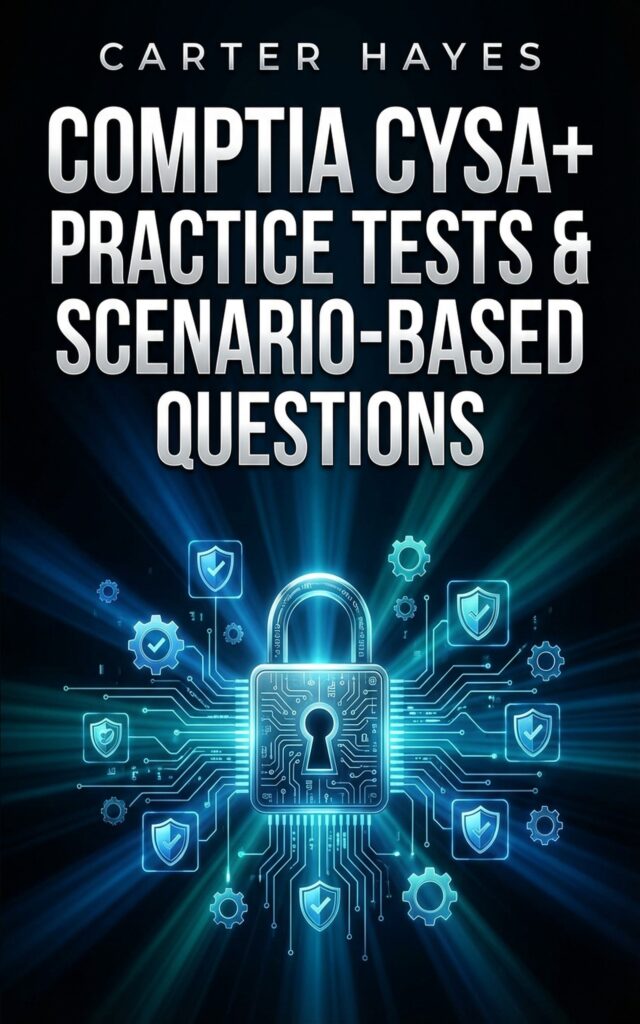
Be the first to review “CompTIA CySA+ Practice Tests & Scenario-Based Questions: CS0-003 Exam Prep with Hands-On Scenarios and Detailed Answer Explanations” Cancel reply
by Carter Hayes
The CompTIA Cybersecurity Analyst (CySA+) certification validates the skills needed to analyze security data, identify threats, and respond to incidents using behavioral analytics and continuous monitoring. It is a mid-level certification that sits between Security+ and advanced credentials like CASP+ or CISSP. CompTIA CySA+ Practice Tests & Scenario-Based Questions is designed to prepare candidates for the CS0-003 exam through realistic practice.
This book provides hundreds of practice questions and scenario-based exercises that reflect the exam’s emphasis on analysis rather than memorization. You will work through questions about threat intelligence, vulnerability management, incident response, security operations, and reporting. Each question is written to test the kind of analytical thinking required on the job, not just the ability to recall terminology.
Every question includes a detailed explanation that walks through the reasoning behind the correct answer and the traps hidden in the incorrect options. The book organizes questions by exam objective, so you can focus your study on the areas where you need the most improvement. Full practice exams at the end simulate the timing and structure of the real CS0-003 test.
This guide is for cybersecurity analysts, SOC analysts, threat hunters, vulnerability management specialists, and anyone preparing for the CySA+ exam. It is also useful for security professionals who want to validate their analytical skills or prepare for a role in a security operations center. The hands-on scenarios make it practical as well as exam-focused.
Official ebook: instant DRM-free download in EPUB and PDF, readable on any device including Kindle.
Not sure yet? Here is the full table of contents and the first chapter, exactly as it appears in the book.
18 chapters in the complete book.
When you decide to pursue the CompTIA Cybersecurity Analyst (CySA+) certification, you’re taking a significant step toward validating your skills in one of the most critical roles in modern information security. Unlike foundational certifications that focus primarily on concepts and terminology, CySA+ requires you to demonstrate practical, hands-on competency in threat detection, analysis, and response. This certification positions you squarely in the operational trenches of cybersecurity, where analysts make real-time decisions that protect organizational assets from constantly evolving threats.
Before diving into practice questions and scenario-based challenges, you need a solid understanding of how the exam itself is structured. The CySA+ exam isn’t just a test of memorized facts. It’s designed to simulate the decision-making processes you’ll face in actual security operations center environments. By understanding the framework, objectives, and assessment methodology, you’ll approach your preparation strategically and maximize your chances of success on exam day.
The CySA+ certification exam, formally designated as CS0-003 in its current iteration, consists of a maximum of 85 questions that you must complete within 165 minutes. This timing works out to just under two minutes per question, though you’ll quickly discover that not all questions consume equal time. The exam combines multiple-choice questions with performance-based questions that require you to complete tasks in simulated environments. The passing score is set at 750 on a scale of 100 to 900, which means you need approximately 83% accuracy to pass. The adaptive scoring methodology makes this calculation more nuanced than simple percentage math.
CompTIA designs its exams using a criterion-referenced approach, meaning your performance is measured against predetermined competency standards rather than against other test-takers. This framework ensures that every certified CySA+ professional has demonstrated the same core capabilities regardless of when they took the exam. Questions are drawn from a large item bank, so no two candidates receive identical exams, though all maintain equivalent difficulty and domain coverage.
The heart of the CySA+ exam lies in its five primary domains, each representing a critical area of cybersecurity analysis work. The first domain, Security Operations, carries the heaviest weight at 33% of the exam content. This domain covers the foundational work of a security analyst: understanding organizational security environments, implementing threat intelligence solutions, managing vulnerability assessments, and analyzing output from security tools. When you encounter Security Operations questions, expect scenarios involving log analysis, alert triage, threat feed integration, and vulnerability prioritization. The emphasis here is on day-to-day operational competency, the skills you’ll use most frequently in an analyst role.
The second domain, Vulnerability Management, accounts for 30% of the exam and focuses specifically on identifying, analyzing, and remediating vulnerabilities across organizational systems. This domain goes beyond simple vulnerability scanning to examine how analysts contextualize vulnerability data within business environments. You’ll need to demonstrate understanding of vulnerability assessment tools, scan configuration, false positive identification, and the critical skill of prioritizing remediation efforts based on risk factors. Questions in this domain often present vulnerability scan results and ask you to determine appropriate next steps or identify which findings represent the most significant threats.
Incident Response and Management comprises 20% of the exam content and tests your ability to detect, contain, eradicate, and recover from security incidents. This domain recognizes that despite best preventive efforts, incidents will occur, and your response determines whether a minor event becomes a catastrophic breach. Expect questions about incident classification, escalation procedures, evidence preservation, root cause analysis, and post-incident reporting. The scenarios often place you in the middle of active incidents where you must make time-sensitive decisions with incomplete information, much like real-world incident response.
The fourth domain, Reporting and Communication, represents 12% of the exam but carries outsized importance in actual analyst work. This domain examines your ability to translate technical findings into actionable intelligence for different audiences. You’ll need to demonstrate competency in creating executive summaries, technical reports, metrics dashboards, and compliance documentation. Questions often present raw security data and ask you to identify appropriate visualization methods, determine relevant metrics for specific audiences, or select proper communication channels for different types of security information. Many candidates underestimate this domain, but organizations consistently cite communication skills as critical differentiators among security analysts.
The fifth and final domain, Security Architecture and Tool Sets, makes up the remaining 5% of the exam but underpins all others. This area tests your understanding of how security tools and architectural patterns support analysis work. You need familiarity with SIEM platforms, endpoint detection and response systems, network traffic analysis tools, vulnerability scanners, threat intelligence platforms, and how these technologies integrate within defense-in-depth architectures. Questions in this domain often ask you to select appropriate tools for specific detection or analysis tasks, or to interpret output from security platforms.
Understanding domain weightings helps you allocate study time effectively. Spending equal time on all domains doesn’t optimize for exam success. A candidate spending weeks mastering architectural concepts while glossing over vulnerability management is misallocating effort given the 30% versus 5% weighting difference. Smart preparation involves spending roughly proportional time on each domain while accounting for your existing strengths and knowledge gaps.
Performance-based questions represent one of the most distinctive (and challenging) aspects of the CySA+ exam. Unlike multiple-choice questions where you select from provided options, performance-based questions place you in simulated environments where you must complete specific tasks. You might need to configure a SIEM rule to detect particular attack patterns, analyze packet captures to identify malicious traffic, prioritize a list of vulnerabilities based on environmental context, or complete an incident response form based on scenario details. These questions typically appear at the beginning of the exam and cannot be skipped and returned to later, so you must complete them before moving to the multiple-choice section.
Performance-based questions assess deeper competency than multiple-choice formats because they require you to apply knowledge rather than simply recognize correct answers. When analyzing a packet capture, you can’t rely on eliminating obviously wrong choices. You must actually understand protocols, traffic patterns, and indicators of compromise well enough to identify them in raw data. This format better reflects real analyst work, where you draw conclusions from primary source information rather than selecting from prefiltered options.
The exam interface for performance-based questions varies depending on the task type. You might interact with simulated security tool interfaces, drag and drop items to complete workflows or classifications, fill in configuration fields, or interact with command-line environments. CompTIA provides a tutorial at the beginning of the exam demonstrating how to interact with these question types, and you should take full advantage of this tutorial to familiarize yourself with the interface mechanics before your time starts counting.
Time management becomes critical given the performance-based question format. With approximately 10 to 12 performance-based questions consuming potentially 40 to 60 minutes of your 165-minute allocation, you have roughly 90 to 120 minutes remaining for 70 to 75 multiple-choice questions. This works out to about 90 seconds per multiple-choice question. Candidates who struggle with performance-based questions often find themselves rushing through multiple-choice items, leading to careless errors on questions they could otherwise answer correctly. Developing efficient workflows for common performance-based question types during your preparation pays significant dividends on exam day.
Scoring methodology for CySA+ exams incorporates psychometric principles that account for question difficulty variation. Not all questions carry equal weight: more difficult questions contribute more to your score than easier ones. This difficulty adjustment means that answering several difficult questions correctly can compensate for missing easier ones, though you obviously shouldn’t intentionally skip questions you find straightforward. Performance-based questions generally carry more weight than multiple-choice items, reflecting their greater complexity and better assessment of applied competency.
CompTIA uses a scaled scoring system ranging from 100 to 900, with 750 representing the passing threshold. This scaling normalizes scores across different exam forms with varying difficulty levels. A score of 750 on a relatively difficult exam form demonstrates equivalent competency to a 750 on an easier form, even though the raw number of correct answers might differ. You won’t receive granular feedback about which specific questions you answered incorrectly, but your score report will indicate performance levels in each domain, helping identify areas for further study if you don’t pass on your first attempt.
The exam doesn’t penalize wrong answers, so you should always provide a response even when uncertain. Random guessing on a five-option multiple-choice question gives you a 20% chance of selecting correctly, while leaving it blank guarantees zero points. For questions where you can eliminate even one or two obviously incorrect options, your odds improve considerably. This no-penalty approach means that time management should focus on maximizing thoughtful attempts rather than leaving questions blank to avoid wrong answers.
Successful CySA+ preparation requires aligning your study approach with your learning style while ensuring comprehensive domain coverage. Visual learners benefit from creating concept maps that illustrate relationships between security tools, processes, and frameworks. They should leverage network diagrams showing information flow through security architectures, and flowcharts depicting incident response procedures or vulnerability management workflows. When studying log formats, visual learners might screenshot examples and annotate them with highlighters to mark key fields. Video-based training content particularly resonates with them, especially demonstrations of security tool interfaces and attack technique visualizations.
Kinesthetic learners require hands-on interaction with security tools and technologies. For them, reading about SIEM correlation rules proves far less effective than actually building rules in a practice environment. Kinesthetic preparation should emphasize virtual lab exercises where you configure security tools, analyze real log files, investigate simulated incidents, and perform vulnerability assessments against practice networks. Open-source security tools provide free options for building home lab environments. Projects like Security Onion offer complete security monitoring platforms, while purposefully vulnerable systems like Metasploitable and DVWA provide safe targets for assessment practice.
Auditory learners excel with discussion-based study methods. They benefit from study groups where participants explain concepts to each other, debate proper approaches to scenarios, and talk through problem-solving processes. Podcasts covering cybersecurity topics, recorded webinars, and audio-based training content complement reading materials for auditory learners. Consider recording yourself explaining key concepts and playing these recordings during commutes or exercise. Teaching concepts to others forces deeper processing than passive review, making study groups particularly valuable.
Reading and writing learners thrive with traditional study methods but should enhance these with active techniques. Rather than simply highlighting text, they should summarize each section in their own words, create detailed study outlines, write practice exam questions for themselves, and maintain comprehensive notes organized by exam domain. Creating flashcards with technical terminology, tool names, and key concepts provides effective review material. Written analysis of practice scenarios, documenting reasoning processes and decision factors, builds the analytical thinking patterns that CySA+ questions assess.
Regardless of learning style, everyone benefits from spaced repetition and active recall practice. Research in cognitive psychology consistently demonstrates that retrieval practice produces stronger learning than repeated review. Spending an hour answering practice questions without reference materials generates more learning than spending that same hour rereading study guides. The testing effect explains why this practice book emphasizes scenario-based questions: working through them actively builds the knowledge and skills the exam assesses.
Your study plan should extend over weeks rather than days, allowing time for information consolidation and skill development. Cramming rarely succeeds for certification exams testing applied competency rather than simple recall. A realistic preparation timeline spans 6 to 12 weeks, depending on your current experience level and available study time. Candidates currently working as security analysts or in related IT security roles may prepare effectively in 6 to 8 weeks with focused study. Those transitioning from other IT fields or with limited hands-on security experience should plan for 10 to 12 weeks of preparation.
Structure your study schedule to progress through domains systematically while regularly reviewing previously covered material. A sample weekly schedule might dedicate primary study time to a new domain while allocating 20% to 30% of study time to reviewing previous domains through practice questions. This approach prevents the frustrating experience of mastering early domains but forgetting them by exam day because you focused exclusively on later material during the final preparation weeks.
Develop strong scenario interpretation skills by analyzing what questions actually ask rather than rushing to answers. CySA+ scenarios often contain extraneous information that mirrors real-world situations where analysts must identify relevant data within noise. Train yourself to identify the core question: Are you being asked to prioritize actions, identify root causes, select appropriate tools, determine proper escalation paths, or interpret technical indicators? Underlining or mentally noting the key question helps maintain focus when scenario details threaten to overwhelm.
Many scenario questions test your ability to apply frameworks and methodologies in context. The Cyber Kill Chain, MITRE ATT&CK framework, NIST Cybersecurity Framework, and NIST incident response lifecycle appear frequently across exam domains. Rather than memorizing these frameworks as abstract lists, focus on understanding how each one guides analyst decision-making. When presented with attack indicators, you should automatically mentally map them to Kill Chain phases, helping predict likely next attacker steps. When responding to incidents, the NIST preparation, detection, analysis, containment, eradication, recovery, and post-incident activity phases provide decision frameworks.
Domain-specific study tactics enhance preparation efficiency. For Security Operations questions, focus heavily on log analysis practice. Work with logs from diverse sources: firewalls, intrusion detection systems, web servers, authentication systems, DNS servers, and endpoint detection tools. Learn to quickly identify anomalous patterns, recognize attack signatures, and correlate events across multiple log sources. Practice with SIEM platforms teaches you how security operations centers aggregate and analyze data at scale.
Vulnerability Management preparation should emphasize CVE and CVSS understanding, vendor vulnerability databases, scanning tool configuration, and contextual risk assessment. Practice analyzing vulnerability scan reports, identifying false positives, and prioritizing remediation based on multiple factors: CVSS scores, exploit availability, asset criticality, environmental context, and compensating controls. Many candidates can identify high-severity vulnerabilities but struggle with realistic prioritization when dozens of findings compete for limited remediation resources.
Incident Response study must cover the complete lifecycle from initial detection through post-incident activities. Build familiarity with incident classification schemes, understand evidence preservation requirements, practice root cause analysis, and develop communication templates for various stakeholder groups. Work through tabletop exercises mentally walking through incident scenarios from initial alert to resolution. This mental rehearsal builds the decision-making patterns the exam assesses.
Reporting and Communication preparation involves studying how to translate technical findings for different audiences. Practice converting vulnerability data into executive risk summaries, writing technical reports for peer analysts, and selecting appropriate metrics for various stakeholders. Understand compliance reporting requirements for frameworks like PCI DSS, HIPAA, and GDPR. Questions in this domain often ask you to identify what information specific audience types need rather than testing technical security skills.
Architecture and Tool Sets study should survey the security technology space. You need functional knowledge of major security tool categories: SIEM platforms, SOAR systems, EDR solutions, network traffic analyzers, vulnerability scanners, threat intelligence platforms, and forensic tools. CompTIA doesn’t test vendor-specific tool operation but rather understanding of what each tool category does, when to apply each tool, and how tools integrate within security architectures. Review the core capabilities and limitations of each category.
The career value of CySA+ certification extends well beyond the immediate goal of passing the exam. This credential validates skills for security operations center analyst positions, vulnerability analyst roles, threat intelligence analyst positions, and incident response team members. Labor market analysis from sources including CyberSeek and Burning Glass Technologies consistently shows strong demand for cybersecurity analysts, with job postings frequently citing CySA+ as a desired or required qualification. Government positions often include CySA+ in approved certification lists for DOD 8570 and 8140 compliance, opening doors to defense contractor and federal agency opportunities.
CySA+ sits at an intermediate level in the cybersecurity certification pathway. It assumes foundational knowledge typically demonstrated by Security+ certification or equivalent experience but doesn’t require the deep specialized expertise of advanced certifications like CISSP or GIAC credentials. This positioning makes CySA+ an excellent next step for professionals holding Security+ who want to validate operational skills before pursuing specialized or leadership-focused certifications. The hands-on nature of this certification also makes it valuable for demonstrating practical competency to employers who seek candidates ready to contribute immediately rather than requiring extensive on-the-job training.
Salary data from sources including PayScale and Glassdoor suggests that cybersecurity analysts with CySA+ certification command median salaries ranging from $70,000 to $95,000 annually, varying by geographic location, experience level, and organization size. More importantly, the certification demonstrates commitment to professional development and validates specific competencies that hiring managers value. In competitive job markets, certifications serve as screening criteria that determine whether your resume reaches human reviewers or gets filtered out by applicant tracking systems.
This credential also provides vendor-neutral validation that carries credibility across different technology environments. Unlike vendor-specific certifications tied to particular products, CySA+ demonstrates transferable analytical and operational security skills applicable regardless of whether an organization uses Splunk or Elastic for SIEM, CrowdStrike or Microsoft for EDR, or Nessus or Qualys for vulnerability scanning. This vendor neutrality increases certification value as your career progresses and you work with different technology stacks.
As you prepare for the CySA+ exam, remember that the certification represents the beginning of continuous learning rather than a terminal endpoint. Cybersecurity threats evolve constantly, new attack techniques emerge, and defensive technologies advance rapidly. The analytical thinking, framework application, and problem-solving approaches you develop while preparing for CySA+ form foundations for career-long learning. The exam tests current knowledge, but the real value lies in developing learning habits and analytical frameworks that serve you throughout your career.
Approach your preparation with patience and realistic expectations. Most candidates don’t achieve mastery on their first pass through study materials. Concepts that seem confusing initially often clarify with repeated exposure and practice application. When you encounter difficult topics, resist the temptation to skip them and move to more comfortable material. Those challenging areas likely indicate knowledge gaps that the exam will expose. Focus additional study time on weak areas rather than repeatedly reviewing topics you’ve already mastered: this targeted approach produces more efficient learning.
The practice questions and scenarios throughout this book provide your most valuable preparation tool. Work through them methodically, analyzing not just correct answers but understanding why incorrect options fail. When you miss questions, resist the urge to immediately look at explanations. Instead, research the underlying concepts independently, then return to explanations to verify your research findings. This active learning approach builds deeper understanding than passive answer review.
Your goal extends beyond passing the CySA+ exam to developing genuine competency in security analysis work. The certification validates your skills, but employers ultimately care about your ability to detect threats, analyze security data, respond to incidents, and communicate findings effectively. Let the exam framework guide your preparation, but maintain focus on building real-world capabilities that will serve you throughout your cybersecurity career. The hours you invest in preparation compound throughout your career as these foundational analytical skills support increasingly sophisticated security work.
With solid understanding of the exam framework, domain structure, and preparation strategies, you’re ready to dive into the practice questions that form the core of this book. Each chapter ahead presents scenarios and questions that mirror actual exam content while building your analytical capabilities. Approach these practice questions as learning opportunities rather than simple assessments, and you’ll find your competency growing steadily as you progress through the material.
… and that is just the beginning. The complete book continues from here, instant download, DRM-free, yours to keep.




Reviews
There are no reviews yet.