By Carter Hayes · Updated 28 October 2026
Last verified 28 October 2026 — every price, title and link on this page was re-checked against the live Reader’s Shack store; Book 2’s listing was confirmed live on 27 and 28 October 2026.
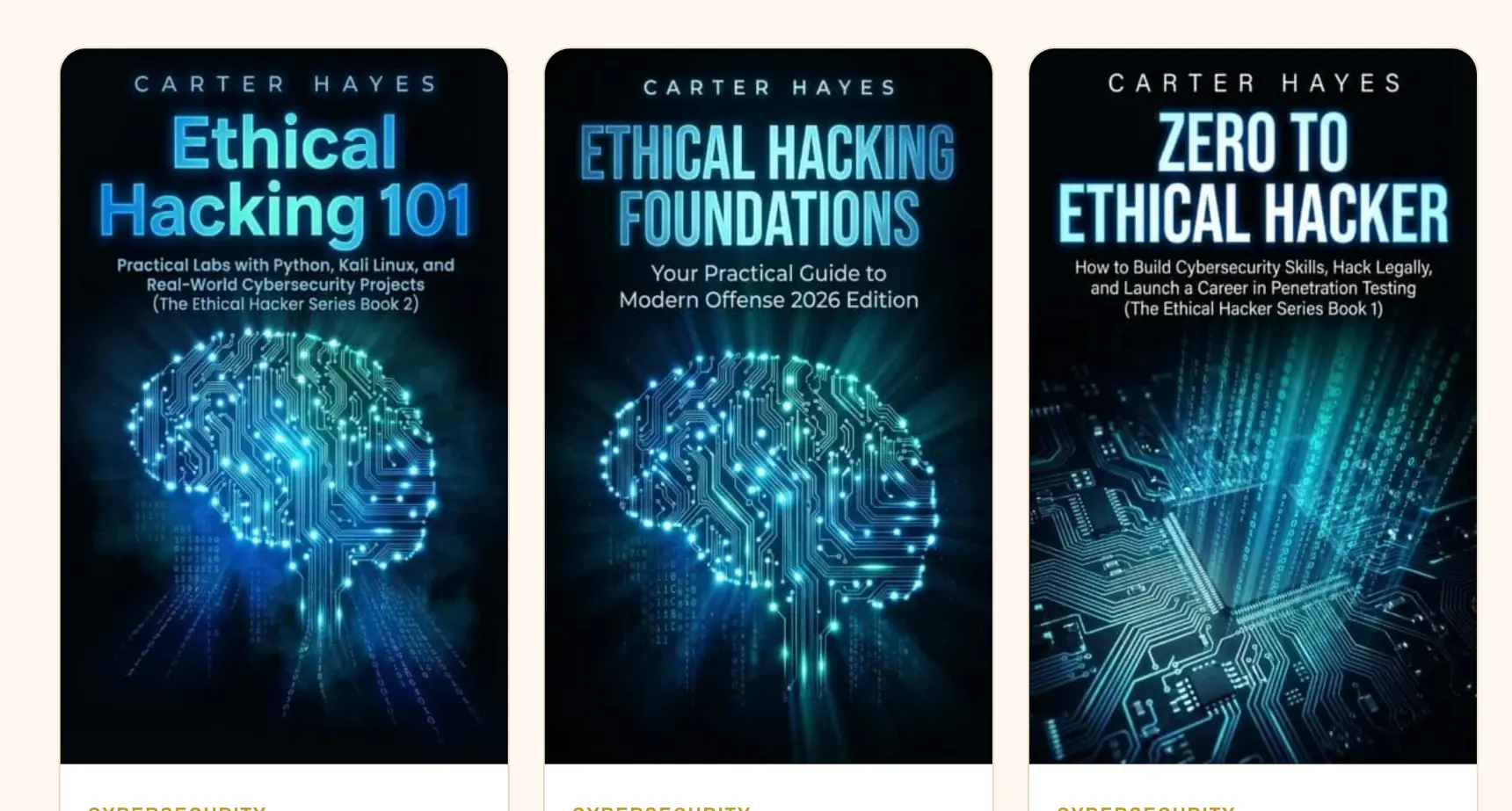
The Ethical Hacker series reading order is simple: read Zero to Ethical Hacker (Book 1), then Ethical Hacking 101 (Book 2), then The Complete Ethical Hacker’s Playbook (Book 3). Book 1 lays the foundations and legal frame, Book 2 drills them through Python and Kali Linux labs, Book 3 runs the advanced strategy — cloud, Active Directory, adversary simulation.
TL;DR Reader’s Shack stocks all three of Carter Hayes’ Ethical Hacker books — each $9.99, DRM-free EPUB + PDF, instant digital download. Zero to Ethical Hacker (Book 1, 18 chapters) is the launch: the legal ground rules, a home lab, the full attack sequence in 18 chapters, and the career map to finish. Ethical Hacking 101 (Book 2, 16 chapters) is the practice layer: practical labs with Python and Kali Linux that walk reconnaissance through post-exploitation as repeatable, real-world projects. The Complete Ethical Hacker’s Playbook (Book 3, 18 chapters) is the advanced strategy volume: attack chains, cloud, Active Directory, adversary simulation and enterprise reporting. Read them in order — 1, 2, 3 — building the lab as you go.
Which book should you read first?
Three books, three jobs: Zero to Ethical Hacker teaches, Ethical Hacking 101 makes you do, The Playbook makes you plan. The correct order is the books’ own numbering, and the contents agree with it. Book 1 supplies the vocabulary — the legal frame, the lab, the attack sequence. Book 2’s chapters take that same sequence — reconnaissance, scanning and enumeration, web application attacks, password attacks, exploitation frameworks, post-exploitation and lateral movement — and walk it again as guided labs you run yourself. Book 3 then lifts the whole craft to engagement level, where the strategy chapters presume both the vocabulary and the reps. A reader without Book 1’s underneath can follow Book 2’s words but not its judgements; a reader without Book 2’s practice reaches Book 3 knowing the terms but not the hands.
| Order | Book | What it does | When it slots in |
|---|---|---|---|
| — | Building a Home Hacking Lab (companion, same shelf) | Hardware, VM and practice-environment choices on any budget | The same week as the lab chapters in Books 1 and 2 |
| 2 | Ethical Hacking 101 (Book 2) | Practical labs with Python and Kali Linux: the attack sequence re-run as real-world projects, from reconnaissance through cloud and scripting to reporting | After Book 1 — practice every sequence it taught |
| 3 | The Complete Ethical Hacker’s Playbook (Book 3) | Strategy-first advanced practice: attack chains, cloud, Active Directory, adversary simulation, reporting | Last — the strategy chapters presume the practice layer |
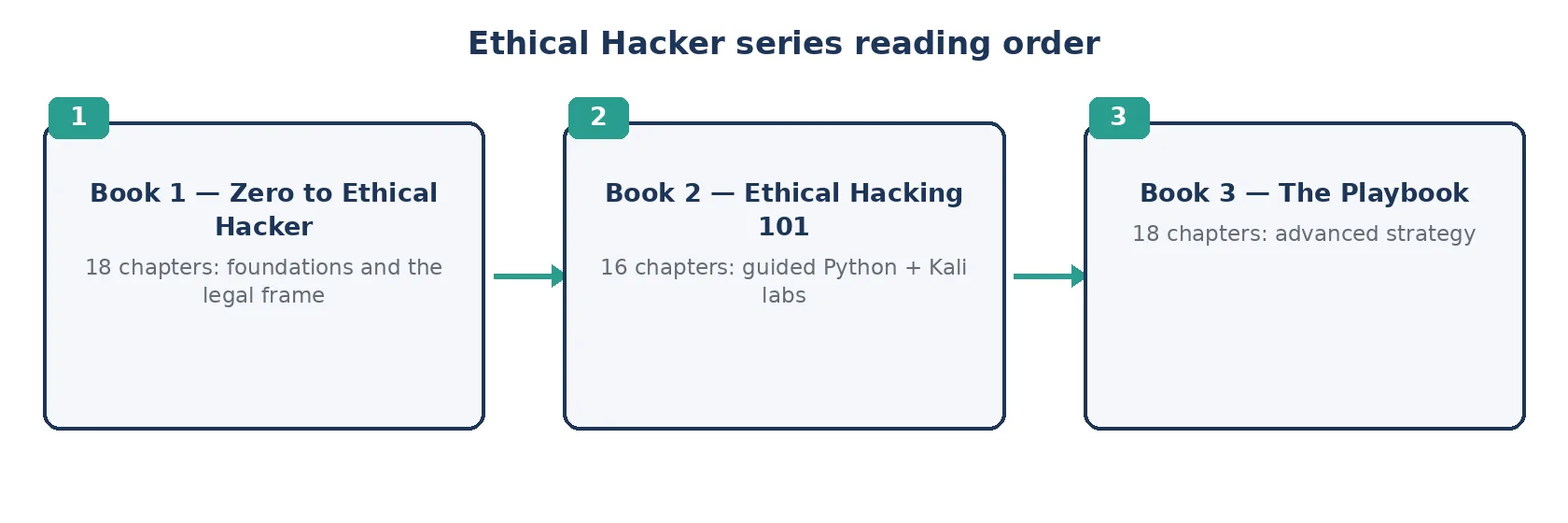
Why this order rather than “read what interests you”: Book 3’s opening chapters — the playbook mindset, reconnaissance theatre, attack-surface mapping — are engagement strategy, and strategy only lands on a base of vocabulary and reps. Book 1 supplies the vocabulary; Book 2 supplies the reps. The reverse is not true: nobody finishes Book 3 and then needs Book 1, except as reference material.
What is the Ethical Hacker series?
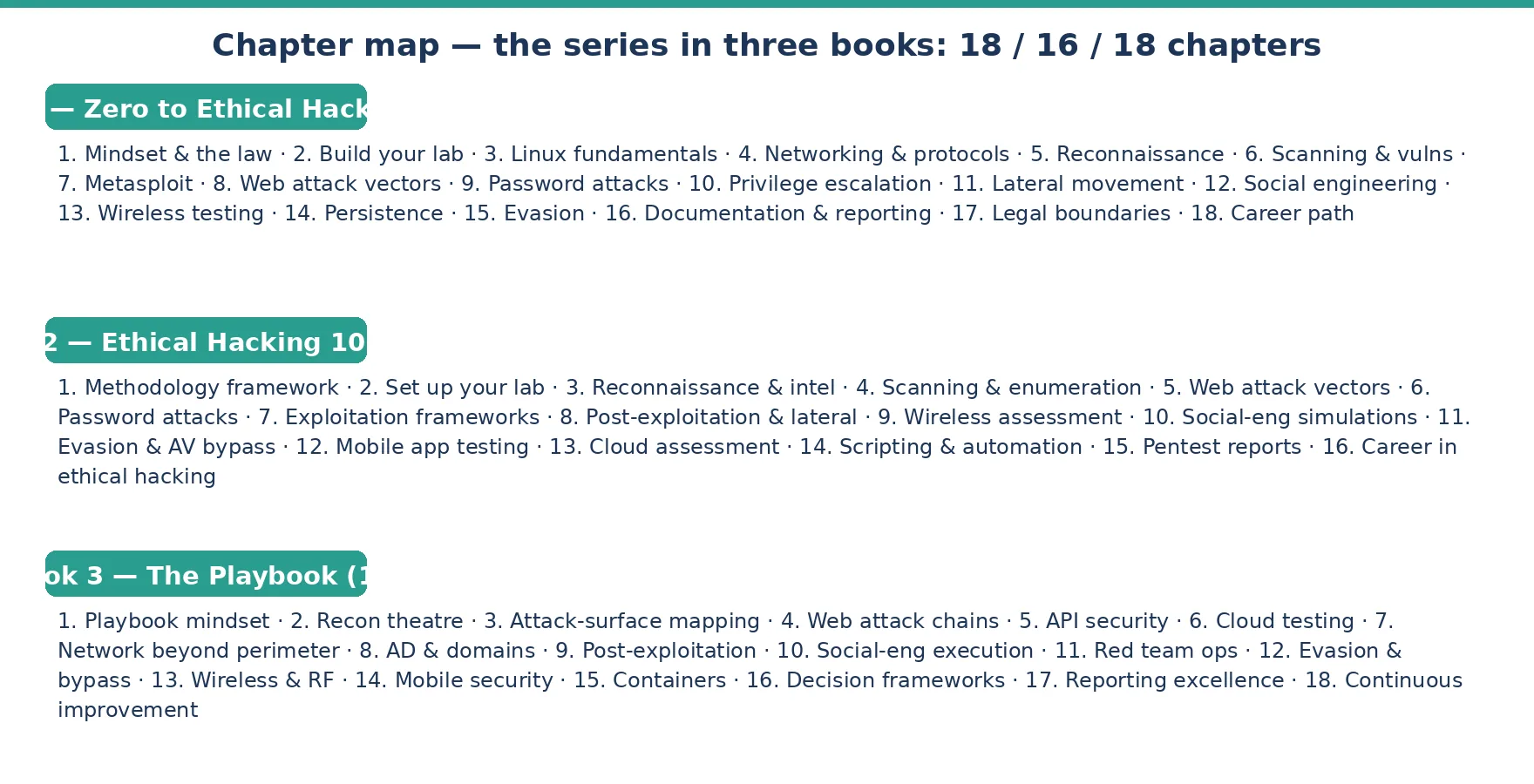
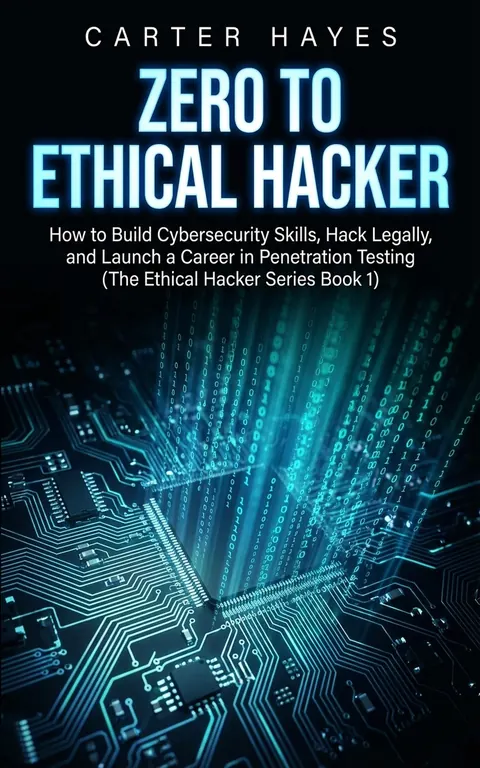
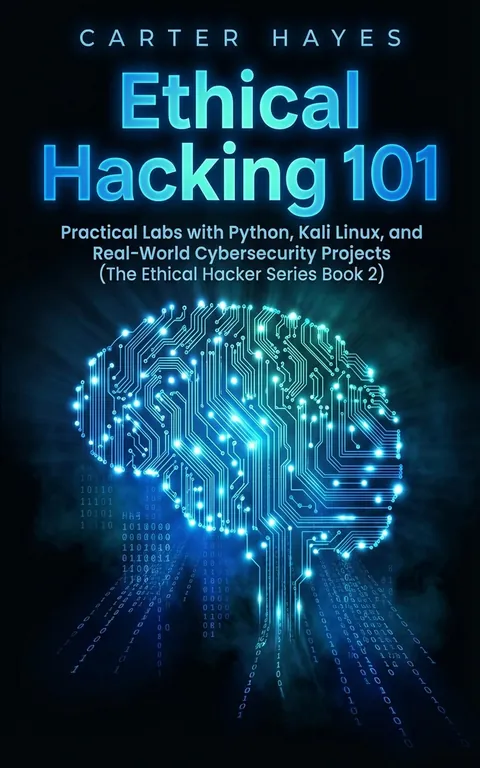
The Ethical Hacker series is Carter Hayes’ security series, published here as DRM-free eBooks — every copy is an instant download in EPUB and PDF, readable on any device including Kindle, at $9.99 each. Book 1 carries the series’ foundational title, Zero to Ethical Hacker: How to Build Cybersecurity Skills, Hack Legally, and Launch a Career in Penetration Testing; Book 2 is Ethical Hacking 101: Practical Labs with Python, Kali Linux, and Real-World Cybersecurity Projects; Book 3 is The Complete Ethical Hacker’s Playbook: Master Advanced Penetration Testing, Social Engineering, and Security Tools. Books 1 and 3 run 18 chapters each; Book 2 runs 16 — and every product page publishes its full table of contents and the entire first chapter before you decide, so the writing style is never a lottery. What follows on this page sticks to what the books themselves, their product pages and the author profile publish — titles, chapter structure and prices. There is no invented series lore here: it is a reading-order page, not fan fiction, and it changed when the catalogue did — Book 2 joined the shelf in late October 2026, and the three numbered titles are the complete series as stocked.
Book 1 — Zero to Ethical Hacker: what it covers
Zero to Ethical Hacker answers the questions the technical classics assume you have already asked: what you are legally allowed to test, what a pentest engagement actually looks like, and how a working career is built. Its first chapter lays out the three pillars that make offensive security lawful rather than criminal — authorization in writing, transparency about methods and findings, and responsible disclosure once a vulnerability is found — and it anchors those abstractions in real stories, from a developer who documents and reports a payment-processing flaw to Dan Kaminsky’s coordinated 2008 disclosure of the DNS cache-poisoning bug, where the vulnerability went public only after a synchronised global patch release.
From there the 18 chapters build in a deliberate sequence. Chapters 2–4 put you on your feet: building the hacking laboratory, learning the Linux fundamentals the toolset rides on, and the networking essentials and protocol analysis that make later chapters legible. Chapters 5–9 are the attack sequence proper — information gathering and reconnaissance, vulnerability identification and scanning, exploitation frameworks with Metasploit, web application attack vectors, and password attacks and credential access. Chapters 10–12 continue it: privilege escalation, lateral movement and pivoting, social engineering and phishing. Chapters 13–15 broaden to wireless penetration testing, maintaining access and persistence, and evading detection; a reader who dislikes that last topic should read it anyway, because the book treats the attacker who has thought about covering tracks as the one who understands what the defender sees.
The closing chapters turn practitioner. Chapter 16 is documentation and reporting — the skill that converts a completed attack into a completed engagement. Chapter 17 returns to the legal and ethical boundaries with the deeper context the first chapter promised. Chapter 18 is the career path — certification thinking, first jobs and specialisation. The book’s product page carries the full table of contents and the entire first chapter; the Read a Sample section is that chapter, unabridged, so the writing style is not a lottery.
Get Zero to Ethical Hacker (Book 1) — $9.99, instant DRM-free EPUB + PDF →
Which chapters stand out in Book 1?
Among the 18, three carry the most weight for a beginner. Chapter 2 (Building Your Hacking Laboratory) decides whether practice happens at all — the book treats the lab as infrastructure rather than formality, which is why our home-lab guide pairs with it below. Chapter 5 (Information Gathering and Reconnaissance) is where the mental model shifts from “hacking” to disciplined evidence-gathering; it is the chapter most readers describe as the moment the field starts making sense. And chapter 16 (Documentation and Reporting) is the professional hinge — the difference between a reader who can break things and a tester an employer pays. A patient reader gets value from all eighteen; a rushed one should refuse to skip those three, because they are the chapters the rest of the series quietly assumes.
Book 2 — Ethical Hacking 101: what it covers
Ethical Hacking 101 is the series’ practice volume — Practical Labs with Python, Kali Linux, and Real-World Cybersecurity Projects, exactly as the cover says. Its sixteen chapters are built as a working loop. The product page’s own description: “each chapter connects ideas to actions, so you understand not only what a technique does but why it works and when to use it”, and the “exercises and examples are built around tools and situations you are likely to encounter in real assessments, labs, and job roles” (product page).
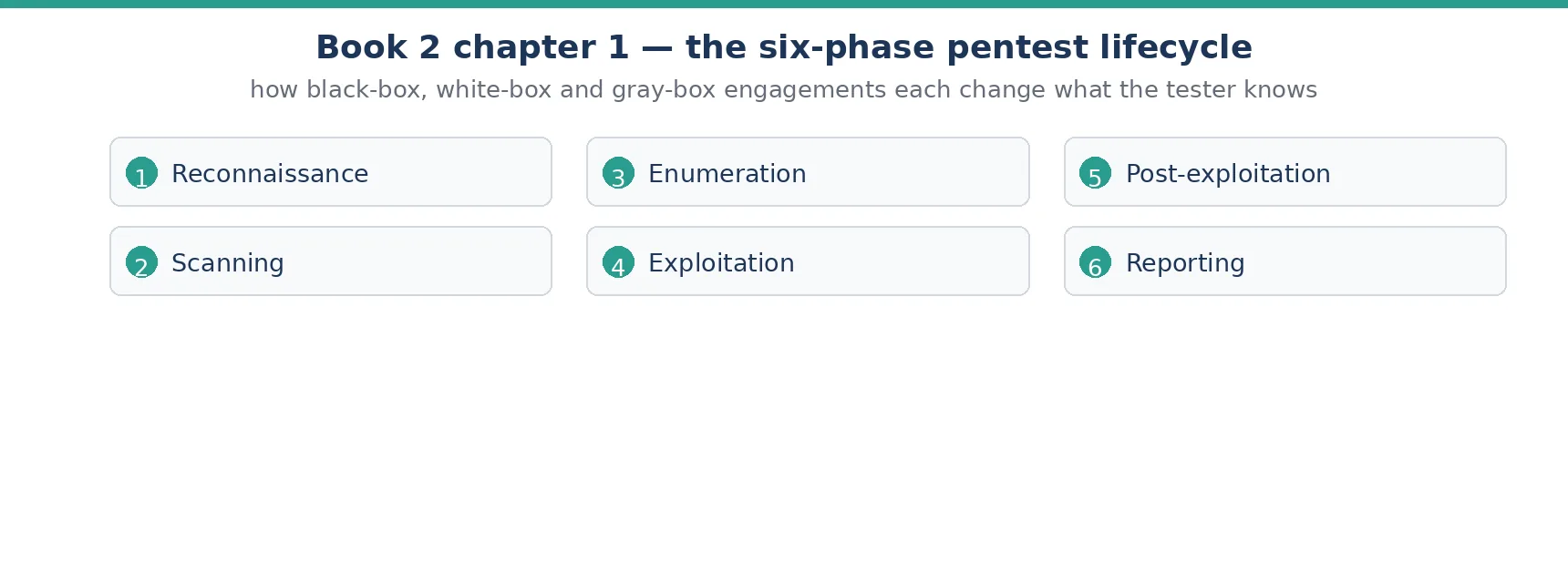
Chapter 1 (The Ethical Hacker’s Methodology Framework) is free to read in full on the product page, and it is a genuine methods chapter rather than an introduction: the six-phase pentest lifecycle — reconnaissance, scanning, enumeration, exploitation, post-exploitation, reporting — how black-box, white-box and gray-box engagements each change what the tester knows, and why structure is the difference between findings and noise. Chapter 2 (Setting Up Your Hacking Laboratory) rebuilds the practice environment, so the book does not presume you kept Book 1’s setup. Chapters 3–8 then re-run the attack sequence Book 1 taught, this time as guided labs: reconnaissance and intelligence gathering, network scanning and enumeration, web application attack vectors, password attacks and credential harvesting, exploitation frameworks and payload delivery, and post-exploitation and lateral movement. Chapters 9–12 broaden the surface the same way Book 1’s did: wireless network security assessment, social-engineering attack simulations, evading detection and antivirus bypass, and mobile application security testing. Chapter 13 (Cloud Security Assessment Strategies) pushes the practice into the cloud; chapter 14 (Scripting and Automation for Hackers) is the title’s Python-and-Kali promise made concrete; and the book closes the professional circuit: professional penetration testing reports (15) and building your career in ethical hacking (16).
Where Book 1 read like a curriculum and Book 3 reads like a command, Book 2 reads like supervised practice: the same sequence, hands on the keyboard. If Book 1 is the textbook, this is the problem set — the book that converts reading time into lab hours.
Get Ethical Hacking 101 (Book 2) — $9.99, instant DRM-free EPUB + PDF →
Which chapters stand out in Book 2?
Four of the sixteen mark the difference this volume makes. Chapter 1 (The Ethical Hacker’s Methodology Framework) is the professional spine — the lifecycle and the box-model approaches any serious engagement runs on, and the full text sits on the product page free. Chapter 2 (Setting Up Your Hacking Laboratory) makes practice possible at any budget. Chapter 14 (Scripting and Automation for Hackers) is where the Python habit forms — the line between running tools and building them. And chapter 15 (Professional Penetration Testing Reports) is the employment hinge, the same one Book 1 plants in its own reporting chapter: the skill that converts a completed attack into a completed engagement. A reader who only does three things from this book should still not skip the reporting lab, because it is the chapter an employer’s review of your work actually reads.
Book 3 — The Complete Ethical Hacker’s Playbook: what it covers
The Playbook is written for the reader who is past the fundamentals — the junior tester who wants to become the person the client calls a trusted advisor. Its first chapter makes the series’ clearest claim about what separates elite testers from adequate ones: not knowing more exploits or owning a bigger toolkit, but thinking about the engagement before touching a keyboard — chess rather than checkers, moves planned against the position rather than the tools.
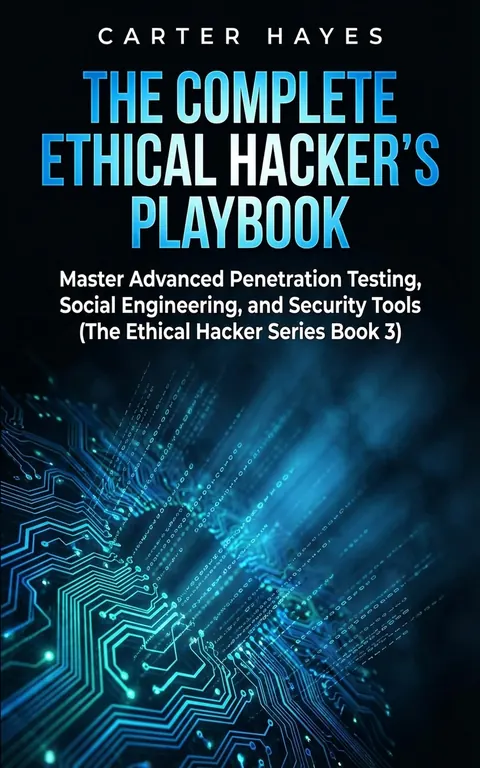
The chapter map runs its own arc. It opens with the strategic layer: the playbook mindset itself (chapter 1), reconnaissance theatre (2) and attack-surface mapping and prioritisation (3). Then the attack chains: web application attack chains (4), API security and modern attack vectors (5), cloud infrastructure penetration testing (6), network penetration beyond the perimeter (7), and Active Directory and Windows domain exploitation (8). Chapter 9 handles post-exploitation and persistence; chapter 10 moves to the human layer again, social engineering attack execution; chapter 11 widens to red team operations and adversary simulation. The technical tail covers evasion techniques and defense bypass (12), wireless and radio-frequency attacks (13), mobile application and device security (14), and container and orchestration security assessment (15).
The last three chapters are the ones reviewers of the series’ approach would point at first: critical decision frameworks and ethical dilemmas (16), reporting excellence and executive communication (17), and continuous improvement and career mastery (18). The book says explicitly what a mature tester knows: that a pentest is ultimately answering business questions, and that the practitioner’s product is not a stack of screenshots but a defensible story about risk that a board can act on.
Get The Complete Ethical Hacker’s Playbook (Book 3) — $9.99, instant DRM-free EPUB + PDF →
Which chapters stand out in Book 3?
Three chapters mark the step up this volume represents. Chapter 1 (The Playbook Mindset) reframes the whole craft around engagement strategy — the chess-against-the-defender framing that separates a scanner operator from a tester. Chapter 8 (Active Directory and Windows Domain Exploitation) is the enterprise reality check: most real environments are Windows domains, and the chapter treats the domain as the primary terrain rather than a special case. Chapter 17 (Reporting Excellence and Executive Communication) decides what every engagement is finally worth, because the client’s decision on each fix you recommend runs through the report. The book would be worth reading for those three alone; the other fifteen make the full arc worth owning, from attack-surface mapping through adversary simulation to the ethics chapter that keeps the whole thing professional.
Who is each book for?
Book 1 is for the complete beginner and the near-beginner: career switchers, IT and support staff who are finding security adjacent to their day job, students who want the field’s ground rules before its tooling. It is deliberately the launch — if you have never built a lab, never run a structured reconnaissance pass and could not describe a pentest engagement life-cycle in one sentence, this is the entry point, and it pairs naturally with our guide to choosing a cybersecurity book for your level.
Book 2 is for the reader Book 1 creates who learns fastest with their hands dirty: the beginner who has the foundations and needs reps before strategy, the student or career-switcher collecting evidence for a first role, and the self-taught reader whose practice so far has been unstructured. On its own telling, the exercises are “built around tools and situations you are likely to encounter in real assessments, labs, and job roles”, and the intended reader is anyone “studying for a certification, building a security career, or protecting your own infrastructure” (product page).
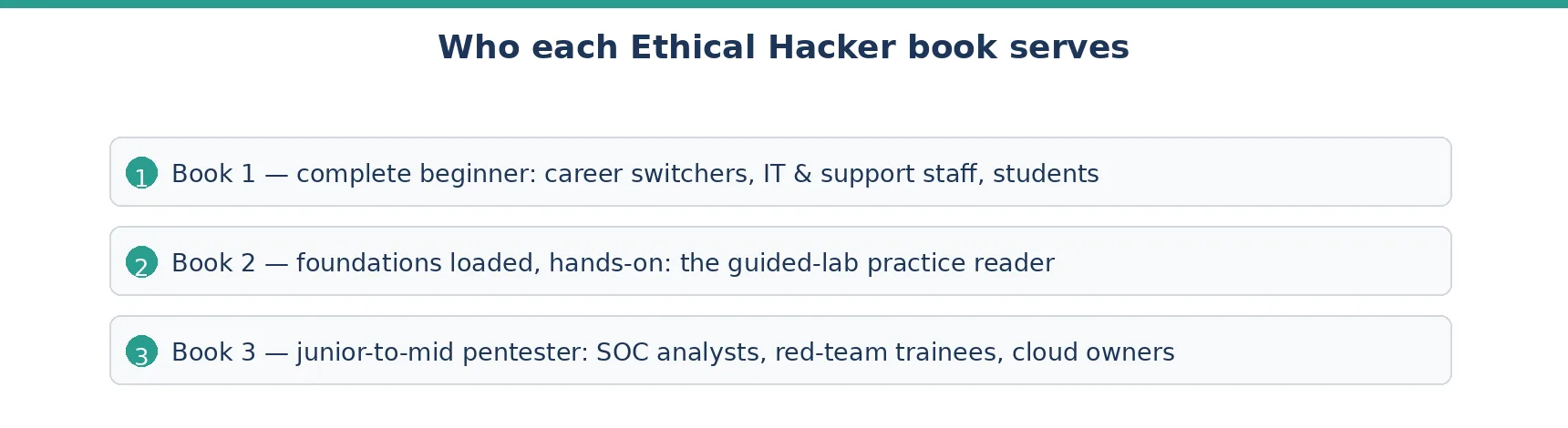
Book 3 is for the reader Book 1 and Book 2 create: the junior-to-mid pentester, the SOC analyst reaching toward offence, the red-team trainee and the infrastructure or cloud owner who wants to see their environment the way adversary-simulation teams do. If you are still deciding whether security fits you at all, start further back with how to start a career in cybersecurity; if you have read Book 1, practise its sequence with Book 2 next; Book 3 is the step after the practice layer, and it reads twice as well on the back of it.
None of the three books is a tool catalogue. All are built around the judgement layer — why a technique belongs in a plan, when to use it, what the defender sees — which is why they hold up better than tool-porn guides as the tools change.
How long does working through the series take?
The honest pacing answer is a practice question, not a reading question. Book 1 is 18 chapters; at one chapter plus its worked lab exercises per week, the foundation pass is roughly a semester of evenings. Book 2 keeps the same cadence and adds the reps: sixteen chapters designed to be done, not just read — this is the volume to keep doing after you finish it, because it is the series’ practice track, not another step on a ladder. Book 3 rewards a slower read — the strategy chapters in particular repay a second pass against your own plan. A realistic plan for a working adult: Book 1 at chapter-a-week with the lab built alongside, Book 2 on the same evenings (one guided lab a week, repeated), Book 3 when you can run the whole attack sequence from memory. Call it eight to twelve months of steady work for the complete arc, faster if you double up — and the sequence stacks rather than lapses, because each book’s vocabulary reappears as assumed equipment in the next.
What does each book assume you already know?
Book 1 assumes general computer comfort — installing software, following a manual through to a working result — and nothing security-specific. Its early chapters build the platform from scratch: the lab first, then Linux, then networking, so the reader who has never opened a terminal is a supported case, not an edge case. Book 2 assumes the same general-computer floor — it sets up its own lab in its second chapter — and it is most useful once Book 1’s sequence is loaded, because its job is to exercise those concepts rather than introduce them. Book 3 assumes Book 1’s outcome set: a working practice environment, command-line fluency, the attack-sequence vocabulary, and the habit of reading a technique as a plan rather than a trick. Where those assumptions are load-bearing they are explicit — cloud infrastructure and Active Directory chapters expect infrastructure instincts that Book 1’s chapters have already built, and the decision-framework chapter expects a reader who has felt the tension of a live engagement, or at least of a lab session that went sideways.
What about certifications alongside the series?
The books teach the field; the certificates certify you — different jobs. If an exam drives your calendar, treat the series as context and pick your study guide from our Security+ study guide roundup or our PenTest+ vs CEH decision guide, and read the series around the syllabus rather than instead of it. The order that works for most readers: certifications first for the hiring signal, Book 1 in parallel for the mental model, Book 2 to fill your evenings with reps the certificates never simulate, Book 3 once the first job or first engagements start — precisely because its engagement-strategy chapters describe situations you will meet early, from scoping conversations to the defender’s-eye review.
How the series fits the wider Reader’s Shack shelf
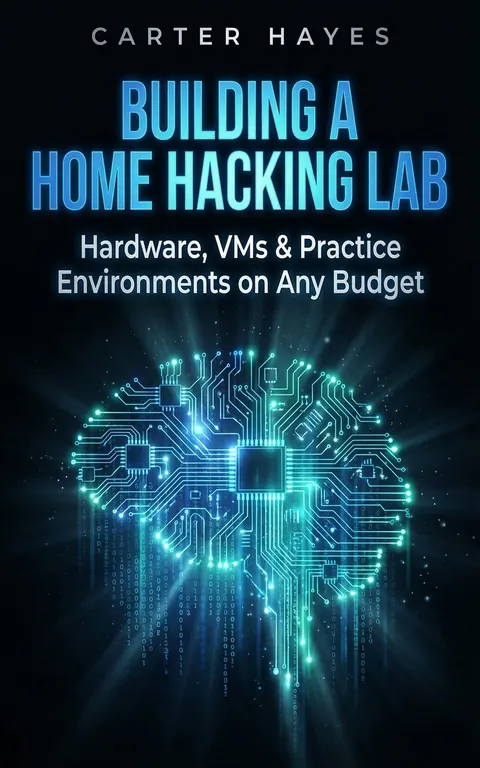
The lab work all three books build around is covered in depth by Building a Home Hacking Lab: Hardware, VMs & Practice Environments on Any Budget — the companion the lab chapters point toward in spirit. The reporting and live-target habit that converts knowledge into engagement practice gets its own volume in Penetration Testing Labs: Hands-On Projects to Build Real-World Skills 2026 Edition. And if you want the series in the context of the wider reading list — where Weidman, Kim, Seitz and Erickson slot in around it — our eight hacking-books list places the whole stack in order with verdicts on each.
What the series doesn’t cover — and which shelf titles do
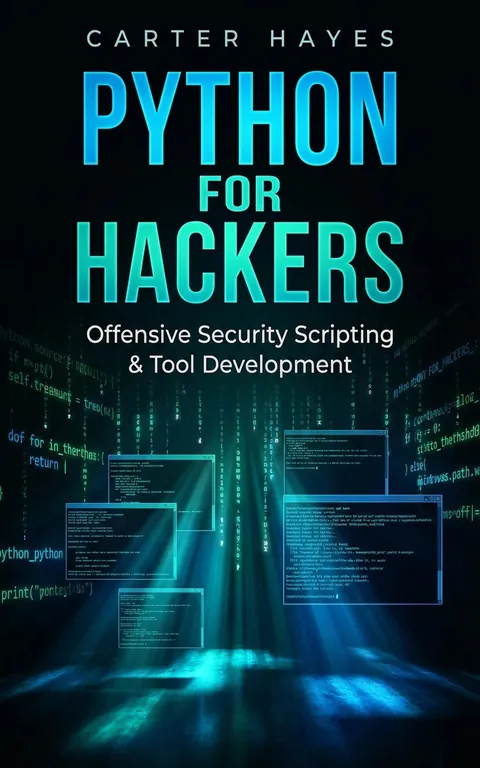
Honesty about scope is part of the reading map. The three stocked books cover the series’ spine — foundations and the legal frame (Book 1), the full sequence as hands-on labs with Python and Kali (Book 2), engagement strategy (Book 3) — and they hand off the deep niches deliberately rather than trying to be everything. Web-application penetration testing, API security and red-team operations each have their own dedicated title on this shelf, and scripting goes further in Python for Hackers: Offensive Security Scripting & Tool Development than Book 2’s automation chapter needs to. If you finish the series and want a single niche done thoroughly, the natural next stops are Web Application Penetration Testing: OWASP, APIs & Modern Exploits and Red Team Operations: Advanced Adversary Simulation & Tactics. The series is the spine; the shelf is the rest of the skeleton.
Frequently asked questions
What order should I read the Ethical Hacker series in?
Read Book 1, Zero to Ethical Hacker, in full and build the lab while you read. Then Book 2, Ethical Hacking 101, as the practice track — its sixteen chapters turn every sequence Book 1 taught into labs built around Python and Kali Linux. Then Book 3, The Complete Ethical Hacker’s Playbook, for the engagement-level strategy. Vocabulary from Book 1 plus reps from Book 2 are exactly what Book 3’s chapters assume.
Is Book 2 (Ethical Hacking 101) worth reading if I have finished Book 1?
Yes — it is the practice layer, live on the shelf since late October 2026. Book 1 teaches the sequence; Book 2 makes you run it: sixteen lab chapters from reconnaissance through cloud and scripting to reporting and career, built around Python, Kali Linux and real-world projects. If your lab hours are thin, read it before Book 3; if you already keep a disciplined practice log, it works as a structured refresher of the whole sequence.
Is Zero to Ethical Hacker good for complete beginners?
Yes — it is built as the launch. It starts from the mindset and legal boundaries, builds your lab and Linux footing before any exploitation, and only then runs the attack sequence, finishing on reporting and the career path. Beginners who want the wider route into the field at the same time can follow our career-start guide.
Is the Playbook (Book 3) too advanced for someone still learning?
If you have worked through Books 1 and 2, no: Book 3’s opening chapters are strategy, not mystery material, and every technique it runs — cloud, Active Directory, adversary simulation — assumes foundations rather than fame. If you have not yet practised the sequence, the Playbook will describe a world you cannot yet work in; read it third and it reads twice as well.
Are these books legal to use?
Each is written around lawful practice in a lab you own or are authorised to test: Book 1 devotes its first and penultimate chapters to authorization, transparency, responsible disclosure and the legal boundaries of offensive security, and Book 2’s opening methodology chapter is built around the same discipline. Stay inside your own practice environment, use targets built for training, and the books themselves make the legal line plain throughout.
What do the books cost and how do they arrive?
All three titles are $9.99 on Reader’s Shack — verified live on the product pages (Books 1 and 3 on 26 October 2026, Book 2 on 27–28 October 2026) — DRM-free, delivered as instant digital downloads in both PDF and EPUB, readable on any device including Kindle. All three product pages publish the complete table of contents and the full first chapter before purchase, so the style and scope are never a blind bet. The only real decision is the order, and that is settled above: 1 → 2 → 3 — the three titles together are the series as stocked.
Start the series tonight
All three are on the shelf now, DRM-free, instant EPUB + PDF, $9.99 each: Zero to Ethical Hacker (Book 1), Ethical Hacking 101 (Book 2) and The Complete Ethical Hacker’s Playbook (Book 3). Read the free first chapters on each product page, buy Book 1, build the lab the same week, and let the order run from there. The rest of the offensive shelf is one click away in hacking books for beginners and penetration testing books, or the full bookshop.