By Carter Hayes · Updated 26 October 2026
Kali Linux Mastery is an 18-chapter guide to the hacking operating system: installing and hardening Kali, running reconnaissance and scans, exploiting with Metasploit, wireless and password attacks, and building your own tooling. It suits beginners switching to Kali as their practice platform and pentesters who want a documented, repeatable workflow.
TL;DR Kali Linux Mastery: The Complete Guide to the Hacker’s Operating System covers the whole Kali working life in 18 chapters — what Kali is and how it is built, installation in every practical scenario, command-line fluency, then the assessment loop (recon, scanning, Metasploit, web applications, wireless, password attacks, post-exploitation) and the craft layer (reporting, custom tools, physical security, advanced network work, mobile and IoT, the defensive view, career development). If Kali is going to be your lab, this is the manual for the lab.
What does Kali Linux Mastery cover?
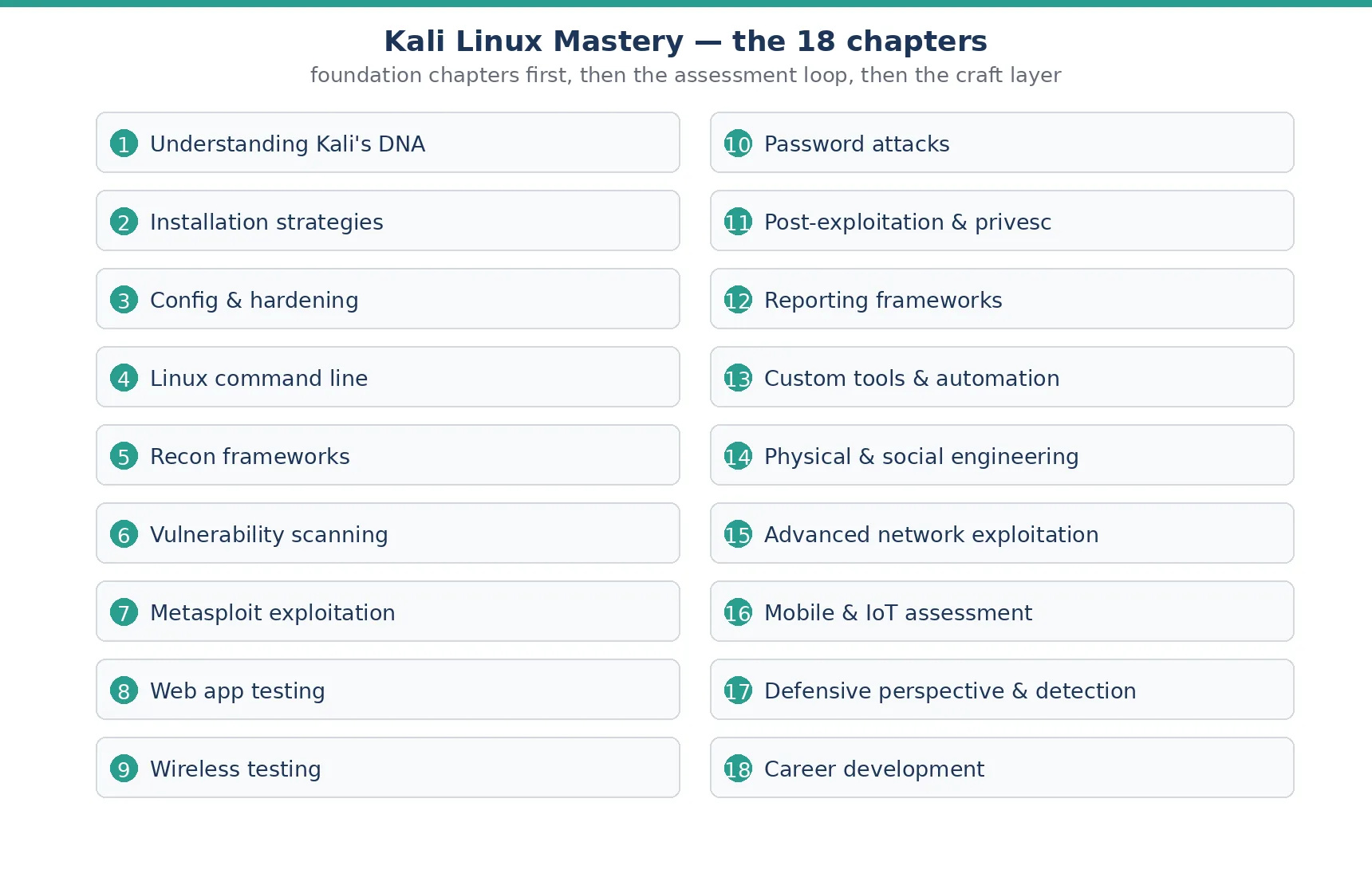
The book is organised the way the work is organised. Chapter 1 (Understanding Kali’s DNA) is a grounded short history: why BackTrack existed, why Offensive Security rebuilt it as Kali in 2013, and why the Debian foundation matters when a tool’s behaviour has to be predictable on a client engagement. Chapters 2–4 put the platform under your hands — installation strategies for every scenario, essential system configuration and hardening, and the Linux command line you will live inside.
The middle block is the assessment loop, and it maps cleanly onto real engagements: information gathering and reconnaissance frameworks (chapter 5), vulnerability scanning and analysis (6), exploitation fundamentals with Metasploit (7), web application security testing (8), wireless network penetration testing (9), password attacks and credential harvesting (10), and post-exploitation with privilege escalation (11). Each of these chapters names the Kali tools for the job — the same taxonomy you will see in the platform’s own tool menus — and the book’s opening chapter counts the default load at over six hundred security tools, curated against maintenance status and modern relevance rather than shipped as a free-for-all.
The closing block is the craft layer, and it is where the book earns a permanent spot on the desk rather than in a drawer: reporting and communication frameworks (12), building custom tools and automation (13), physical security and social engineering (14), advanced network exploitation (15), mobile and IoT assessment (16), the defensive perspective and detection (17), and career development with continuous learning (18). That last pair is a quiet differentiator: a reader who works both directions — offensive craft and how it is watched — finishes the book usable on either side of an engagement.
Who is Kali Linux Mastery for?
Two readers, most of the time. First, the newcomer with basic computer comfort — comfortable enough to install an operating system and follow instructions — who wants to start hacking practice inside Kali rather than around it: the book starts at installation and takes the command line from scratch, so the Linux-experience question is answered inside the book, chapters 2–4, not before it. Second, the junior-to-mid penetration tester whose workflow has drifted into tool-specific muscle memory and wants one documented sequence to hang every assessment on.
It is not the right first book for someone who hasn’t yet decided security is the field they are entering — our guide to choosing a cybersecurity book for your level helps that decision, and the series’ own Zero to Ethical Hacker handles the ground rules and the career map first. Our eight-hacking-books reading list places every title in the wider order. It is also not a cram book: certification candidates get their mapped exam guides elsewhere on this shelf, and anyone still weighing the field itself can start with starting a career in cybersecurity.
How should you work through the book?
One chapter, one lab session, repeated. The book’s structure makes this possible because every technique chapter names its tools before it teaches them — read the chapter, then open the practice environment and reproduce the pass: a reconnaissance sweep in chapter 5’s frameworks, a scan-and-verify loop in chapter 6, one Metasploit module end-to-end in chapter 7. The practice environment itself should not be improvised; our home hacking lab guide covers the hardware, virtual machine and practice-target choices on any budget, and it is the right companion purchase to make the same week.
Work the chapters in order — chapters 5–11 are a sequence, each assuming the last — and treat chapters 12–13 (reporting, custom tooling) as the two that turn exercises into engagements. Chapters 16–18 reward a second pass later: mobile and IoT, the defensive view, and the career chapter read differently once you have done a full loop against your own practice machines.
What is Kali Linux, and why does it matter?
Kali Linux is the industry-standard penetration-testing platform — the project’s own framing, kept deliberately: not merely a collection of tools, but a platform optimised so a professional can sit down and go, with the toolset curated, organised by assessment phase, and available practically everywhere (bare metal, virtual machines, containers, ARM devices, live USB, Windows WSL). It descends from BackTrack, ships with Xfce as its default desktop, and publishes on a rolling base with stable point releases at a steady quarterly cadence — 2026.1 arrived in March 2026 and 2026.2 followed in late June with desktop refreshes and new tooling, so the “latest version” you should expect to read about changes roughly with the seasons. That cadence is exactly why Kali Linux Mastery teaches tool categories and workflow rather than pinned builds: the categories outlast the release numbers, and the book’s own first chapter says as much in its history of how Kali is curated.
A practical note on where Kali runs. The platform’s own site documents installs on bare metal, inside virtual machines, as containers, on ARM devices, as a live USB, and through Windows’ WSL layer, with Xfce as the default desktop and a documentation portal carrying the setup recipe for each — which is why the book’s installation chapter and the official docs reinforce each other rather than compete. The recent releases kept the quarterly rhythm too: 2026.1 in March brought the annual theme refresh and a BackTrack-anniversary nod, 2026.2 in late June followed with desktop refreshes and new tooling. A reader on any of those versions meets the same tool categories in the same menus, and the book’s install-strategy chapter exists precisely so that version churn never blocks a lab — you pick the install shape that fits your hardware and practise there.
Frequently asked questions
Do I need Linux experience before starting Kali Linux Mastery?
No — the book builds it. Installation (chapter 2), system configuration and hardening (chapter 3) and the command line (chapter 4) come before any attack material, so the Linux learning curve is inside the book rather than assumed before it. Readers starting from zero Linux can simply go slower in the first four chapters.
Which Kali version does the book track?
None specifically, on purpose. Kali publishes quarterly stable releases on a rolling base — 2026.2 is the current release line as of mid-2026 — and tool menus move between releases. The book teaches the categories, the workflow and the curation logic, which outlast any single release number.
Is Kali Linux Mastery a certification prep book?
No. It is a platform-and-practice manual; certifications need syllabus-mapped guides, and this shelf keeps them separate — see the Security+ SY0-701 study guide resources if an exam drives your calendar. The book’s own chapter 18 explains how certifications slot into a Kali-ground career. (Kali itself publishes quarterly stable releases on a rolling base — 2026.1 in March 2026, 2026.2 in late June, and the line keeps moving — so expect tool menus to change with the seasons; the workflow does not.)
How much lab do I need to run alongside the book?
Less than most people expect — and less than a classroom. The book’s early chapters assume a practice environment, not a commercial one: an ordinary computer running virtual machines covers every assessment-loop chapter, and the home hacking lab guide sorts the hardware, VM and practice-target choices on any budget. Every technique chapter names its tools, so the lab work maps onto the reading step by step.
Is learning Kali Linux legal?
Yes, and the book keeps the line visible: every technique chapter is written for lab and authorised-assessment use, and its opening chapter is explicit that tools pointed at systems you do not have permission to test cross into crime in virtually every jurisdiction. Practise on your own lab and purpose-built targets.
Get the book
Kali Linux Mastery: The Complete Guide to the Hacker’s Operating System is $9.99 on Reader’s Shack — instant DRM-free download in EPUB and PDF, readable on any device including Kindle, with the full first chapter readable free on the product page before you decide. Build the lab the same week with the home hacking lab guide, or browse the penetration-testing shelf and the full bookshop. And when the rest of the series’ context matters, the Ethical Hacker series reading-order hub has the order mapped.