By Carter Hayes · Updated 26 October 2026
PowerShell for Red Teamers is an 18-chapter offensive PowerShell guide: execution and evasion basics, initial access and payload delivery, Active Directory reconnaissance with PowerView, lateral movement, persistence, fileless techniques, command and control — and it closes on the blue-team view of every technique. It is for working testers who attack Windows.
TL;DR PowerShell for Red Teamers: Windows Exploitation & Post-Exploitation teaches PowerShell from the red-team side of the glass in 18 chapters: red-team fundamentals (1), obfuscation and evasion (2), initial access and payload delivery (3), credential access (4), PowerView/AD reconnaissance (5), privilege escalation (6), lateral movement and remote execution (7), persistence (8), defense evasion and anti-forensics (9), network pivoting (10), data exfiltration (11), Kerberos attacks (12), fileless and in-memory execution (13), command and control (14), whitelisting bypass (15), cloud exploitation (16), operational tradecraft (17), and detection engineering from the blue team’s side (18).
Why PowerShell matters in red teams
PowerShell’s power is the same fact that makes it a defensive headache: it is not a text shell but a privileged execution environment wired into Windows itself. MITRE ATT&CK technique T1059.001 describes the offensive reading of that statement — “PowerShell is a powerful interactive command-line interface and scripting environment included in the Windows operating system” — with adversaries using it for discovery, code execution, and payloads that run from disk or in memory. The named offensive tooling families on the same ATT&CK page — Empire, PowerSploit, PoshC2, PSAttack — are all PowerShell-native, which tells you where the tradition runs.
The book’s own first chapter frames the same picture from the working side: “the very features that enable system administrators to manage thousands of machines efficiently can be leveraged by red teamers to move laterally, execute code, exfiltrate data, and maintain persistence across Windows environments”. Real incident data agrees with both statements at once — the same ATT&CK catalogue records PowerShell used by groups like Akira for credential harvesting and privilege escalation, and in the Sandworm operations against Ukrainian power infrastructure for in-memory credential harvesting and spreading a wiper through Group Policy. A testing tradition that strong is worth learning properly rather than incidentally.
What does the book cover?
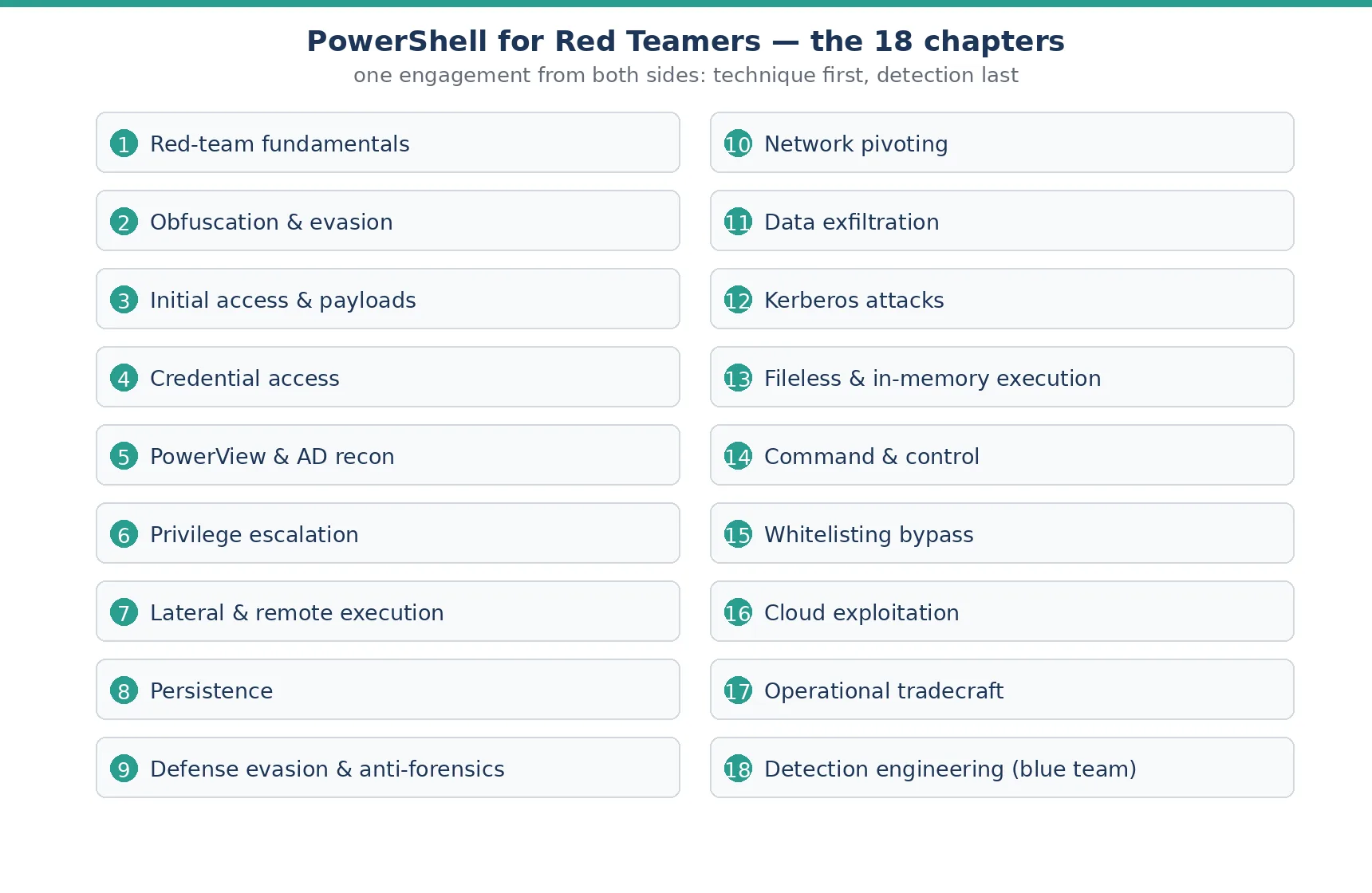
The 18 chapters follow one engagement from both sides. The opening chapter sets the foundations — the PowerShell engine and hosting-process architecture, the option of running code without touching powershell.exe (by loading System.Management.Automation directly), the .NET surface the language rides, and remoting over WinRM (ports 5985/5986) as the lateral-movement channel that blends with administrative traffic.
The technique core then runs the engagement sequence: obfuscation and evasion before anything touches the wire; initial access and payload delivery; credential access and harvesting; PowerView-driven Active Directory reconnaissance; local privilege escalation; lateral movement and remote execution; persistence mechanisms; defence evasion and anti-forensics; network reconnaissance and pivoting; and collection with data exfiltration. Three specialised chapters follow on the deepest material: Kerberos attacks with PowerShell, fileless malware and in-memory execution, and command and control from within PowerShell. Chapter 15 takes on application whitelisting bypass, and chapter 16 carries the material into cloud exploitation — an increasingly common engagement surface now that the cloud config error rather than the workstation is the way in for many attackers.
Chapter 17 pulls the whole sequence into operational tradecraft, and chapter 18 is the book’s deliberate full stop: detection engineering and the blue-team perspective. Every offensive chapter is readable against it — the defender’s chapter explains what script block logging, AMSI-integrated telemetry and behavioural analytics see when the earlier chapters’ techniques run, and that double view is the point: a red teamer who cannot describe the blue team’s sightline is performing theatre, and this book refuses to let the reader finish without both.
Is the execution policy a security boundary?
No — and Microsoft says exactly that. PowerShell’s execution policies are a set of levels from RemoteSigned to Restricted that control how configuration files load and scripts run, and Microsoft’s documentation describes the feature plainly: “PowerShell’s execution policy is a safety feature that controls the conditions under which PowerShell loads configuration files and runs scripts. This feature helps prevent the execution of malicious scripts.” The same page is blunt about what it is not: “The execution policy isn’t a security boundary, it’s defense in depth. For example, users can easily bypass a policy by typing the script contents at the command line when they can’t run a script.” — about_Execution_Policies, Microsoft Learn
The book makes the same argument from the attacker’s side — including the classic inversions such as piping script content straight into a fresh powershell.exe -NoProfile session — and then adds the defender’s read: organisations that rely on execution policy alone are telling you how little is actually measured, while mature environments run layered controls. The version-history section carries the chapter’s most useful history lesson: PowerShell 2.0 shipped with none of the modern telemetry, and its residual presence is a known downgrade avenue, which is why the environment survey chapter teaches discovery of available versions as an estimate of defensive maturity.
Who is PowerShell for Red Teamers for?
Working red teamers and penetration testers who attack Windows estates — the book assumes you can already drive a lab, and that your target world includes Active Directory. Sysadmins are the second natural audience: the reader who has administered Windows for years but never seen the same surface from the adversary’s side, whose daily PowerShell fluency becomes offensive capability fast. SOC analysts and detection engineers get the inverse view from chapter 18, which is why this is the rare companion that reads usefully from both sides of an engagement.
It is not the right first book for someone who hasn’t yet mastered basic scripting or built a lab — start earlier in the shelf. Newcomers deciding their direction should take Zero to Ethical Hacker first, place this title in the wider stack with our eight-hacking-books reading list, and settle the question of certs versus skills with our PenTest+ vs CEH — certification or skill first decision guide. Readers starting the field from the beginning can also follow how to start a career in cybersecurity.
How should you work through the book?
One chapter at a time, inside an Active-Directory-shaped lab. The lateral-movement, Kerberos and PowerView chapters are only worth the paper without domain infrastructure to point them at — stand up a small practice domain (domain controller, two member machines, one workstation) and every technique chapter gets a target. The book’s chapter sequence maps cleanly onto a four-to-six-week practice arc: foundation chapters first with every cmdlet typed rather than pasted, the engagement-sequence run next, then the specialised chapters as their prerequisites land. Finish chapter 18 with the blue-team lens open in parallel — re-read chapter 2 (obfuscation) and chapter 9 (defence evasion) against it, and the pair snaps into place as one picture. The Windows-estate neighbour volume is Active Directory Attacks & Defense: Enterprise Penetration Testing; the series’ launch volume and reading order live on the Ethical Hacker series hub.
Frequently asked questions
Is PowerShell for Red Teamers suitable for beginners?
With a caveat: it assumes a working lab and basic Windows administration. The first chapter builds foundations from the engine architecture up, and an administrator’s daily PowerShell fluency carries a long way. Absolute beginners should start with a foundations title first and let this be the second or third book — which is exactly what the series reading order lays out.
Does the book still apply as Microsoft hardens PowerShell?
The book’s own defensive chapters cover that evolution — script block logging, AMSI and constrained language mode are the reason the blue-team chapter exists. Modern PowerShell hardening pushes adversaries toward the techniques the later chapters teach: memory-resident execution and off-process engine loading. The harder the shell is to watch, the more the shell’s internal architecture is worth knowing rather than tool invocation.
Do I need Active Directory knowledge before starting?
Basic familiarity, yes — the PowerView, Kerberos and lateral-movement chapters are easiest with the concepts already loaded, and the lab work assumes a domain to practise on. The AD fundamentals are covered at the depth needed to follow along, and the neighbouring shelves offer deeper AD volumes when the book’s chapter 5 leaves you hungry.
Is this a book about malware?
No. It teaches authorized red-team tradecraft in PowerShell — the same techniques an assessment contract requires and a detection engineer needs to understand — and it closes with the defensive chapter that keeps the whole work inside its professional lane. Every chapter is written for lab and authorised use, and the engagement-planning discipline runs through it.
Get the book
PowerShell for Red Teamers: Windows Exploitation & Post-Exploitation is $9.99 on Reader’s Shack — instant DRM-free download in EPUB and PDF, readable on any device including Kindle, with the full first chapter free on the product page before you decide. Pair it with the Active Directory volume for the estate work, browse the penetration-testing shelf or the full bookshop, and map the wider series on the Ethical Hacker series reading-order hub.