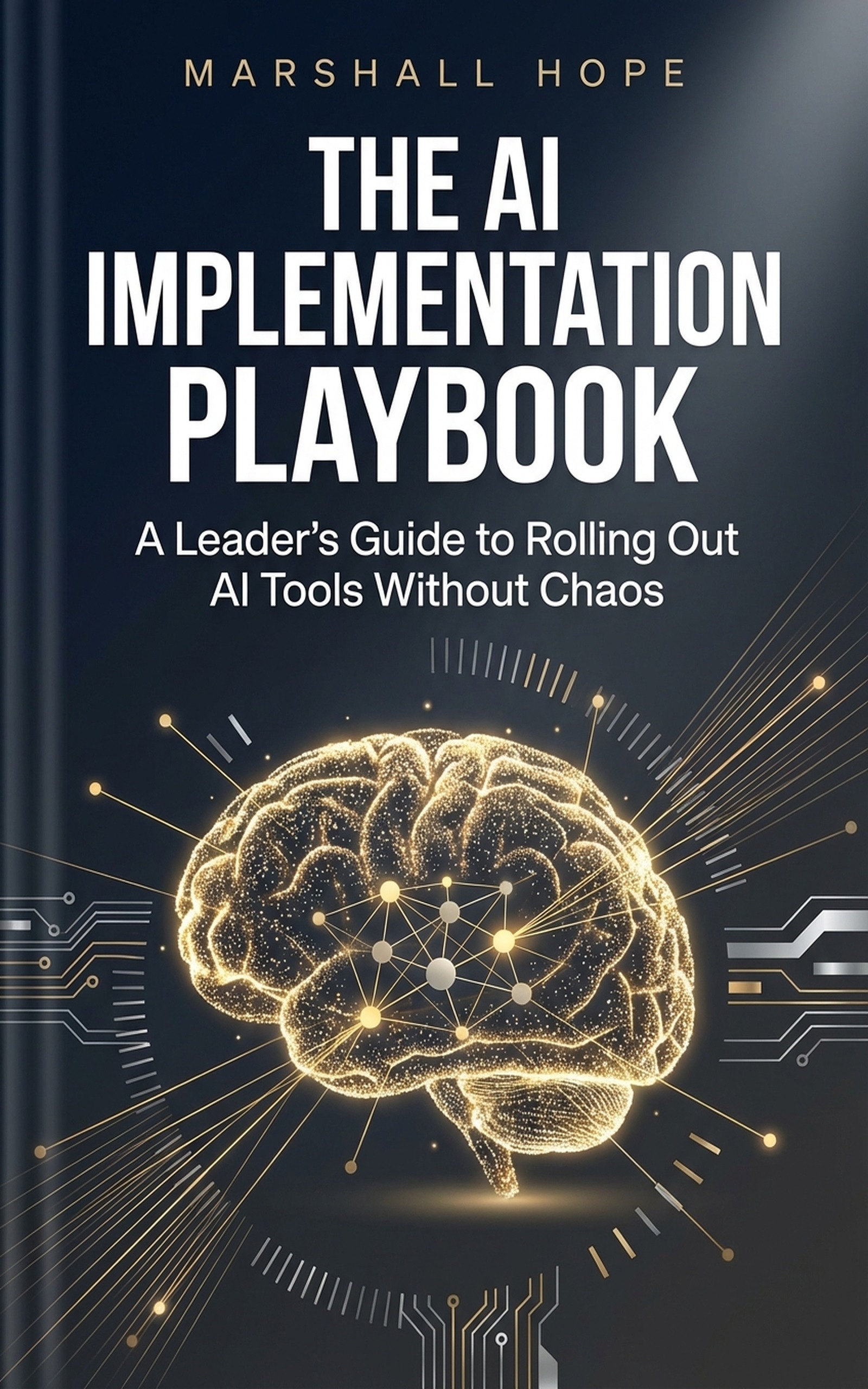
Description
====================
Marshall Hope’s “The AI Implementation Playbook” arrives as an essential guide for organizations navigating the transformative yet treacherous waters of artificial intelligence adoption. At its core, this comprehensive manual addresses the fundamental question facing modern businesses: not whether to implement AI, but how to do so successfully, sustainably, and ethically. The book’s central thesis positions AI implementation as a strategic organizational transformation rather than merely a technological upgrade, requiring careful orchestration of human, cultural, and technical elements.
The emotional arc begins with urgency and cautious optimism, acknowledging both the immense potential and genuine risks of AI adoption. As readers progress through the twenty chapters, the tone shifts from foundational understanding to confident capability-building, ultimately arriving at empowered pragmatism. Hope maintains a balance between inspiration and realism, neither overselling AI as a panacea nor dismissing valid concerns about displacement, bias, and control. The mood is decidedly practical and accessible, demystifying complex concepts without condescension.
Key visual imagery emerges through Hope’s recurring metaphors: the “implementation bridge” connecting current operations to AI-enhanced futures; the “neural network” representing organizational interconnection and data flow; the “dashboard” symbolizing transparency and measurable progress; “guardrails” representing ethical boundaries and risk management; and the “feedback loop” illustrating continuous learning and adaptation. These concrete visual anchors ground abstract AI concepts in tangible organizational realities.
The target audience encompasses business leaders, technology managers, and organizational change agents who recognize AI’s inevitability but feel overwhelmed by implementation complexity. This book fulfills the need for a structured, actionable roadmap that bridges the gap between AI’s theoretical promise and practical deployment. It promises transformation from confusion to clarity, from reactive anxiety to proactive strategy, equipping readers to lead confidently rather than stumble blindly into the AI era.
The narrative structure progresses logically through assessment, strategy formation, team building, pilot programs, scaling, governance, and long-term optimization. Each chapter builds upon previous foundations, creating a cohesive implementation framework. Hope distinguishes this work through extensive real-world case studies, candid discussion of failure modes, and integration of human-centered design principles alongside technical considerations. The playbook format itself—with checklists, decision matrices, and templates—makes the content immediately actionable, setting it apart from purely theoretical AI literature.
====================
Reviews
There are no reviews yet.